
Part of the guide Android SMS Gateway App and APK: Unlimited SMS
On this page
- Key takeaways
- What is a cloud SMS API?
- What is a phone SMS gateway?
- How do cloud SMS prices compare in 2026?
- Which has better deliverability?
- How does compliance differ?
- How much throughput do you get?
- Why do teams switch to a phone gateway like SMS8?
- Side by side: cloud SMS API vs phone gateway
- How hard is it to move from a cloud API?
- Should you switch to a phone gateway?
Key takeaways
- A cloud SMS API rents you a number and charges per message segment, plus carrier fees. A phone gateway sends through your own SIM on a flat fee.
- For local, two-way texting at small and mid volume, a phone gateway is usually far cheaper and skips A2P 10DLC registration in the US.
- Throughput is the main limit of a phone gateway: SMS8 paces bulk sends at one message every 10 to 30 seconds per SIM, and you add phones to send more.
- SMS8 adds iMessage from a Mac you own, signed webhooks, an MCP server and official apps for GoHighLevel, Zapier, Make, WordPress and Google Sheets, with a 3-day trial and no card.
A cloud SMS API and a phone SMS gateway both let your software send texts with an HTTP request, but they reach the carrier in different ways. A cloud SMS provider such as Twilio, Vonage, Plivo, Telnyx or Bird connects to carriers over business routes and bills you per message segment. A phone gateway, such as SMS8, sends each text from an Android phone and SIM you own, so the carrier sees a normal text from a person, and you pay a flat monthly fee. For a business texting its own customers, the phone gateway is the better deal: a number customers know, no per-message fee and no A2P 10DLC filing.
This article is part of our guide to Twilio alternatives in 2026. Below we compare the two models on cost, deliverability, compliance and throughput, and show why teams move their texting to a gateway on their own phone.
What is a cloud SMS API?
A cloud SMS API (often called CPaaS, communications platform as a service) gives you numbers you rent and an endpoint to send through them. Your request goes to the provider's servers, the provider passes it to carriers over application-to-person (A2P) routes, and the carrier delivers it. You pay per segment, per number per month, and in the US you pay the carrier fees that providers pass through on business traffic.
The big names are Twilio, Vonage, Plivo, Telnyx and Bird (formerly MessageBird). They all offer roughly the same core: long codes, toll-free numbers, short codes, delivery receipts, webhooks for replies, and coverage in many countries.
What is a phone SMS gateway?
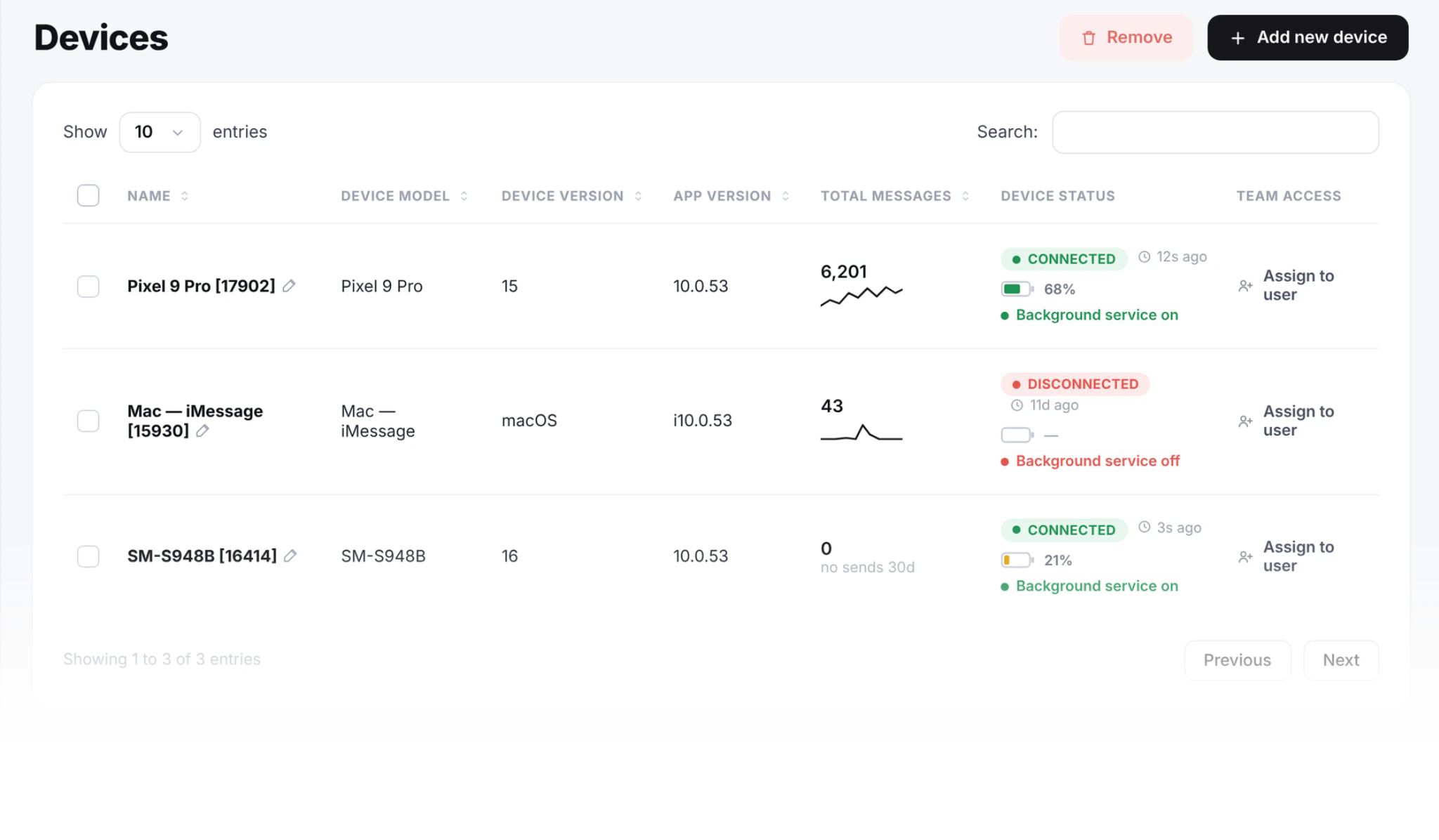
A phone gateway turns a real phone into the sender. With SMS8, you install the app on an Android phone (Android 7 or later), pair it with your account, and your software calls the SMS8 API or one of its integrations. SMS8 hands the message to the phone, and the phone sends it from its SIM like any text you type by hand. Replies come back to the same number and reach your dashboard, your webhooks or your CRM.
Because the text leaves an ordinary SIM, it is person-to-person traffic from the carrier's point of view. There is no number to rent and, in the US, no A2P 10DLC brand or campaign to register. You can also send iMessage from a Mac you own with the SMS8 Gateway Mac app, with SMS fallback.
How do cloud SMS prices compare in 2026?
Cloud providers price the US differently, and the headline rate is never the whole bill. The rates below come from each provider's own US pricing page, as listed on their site in November 2026.
| Provider | US outbound SMS (long code) | Carrier fees | Number per month |
|---|---|---|---|
| Twilio | $0.0083 per segment | Extra, $0.0035 to $0.005 per message on a long code | $1.15 |
| Plivo | $0.0077 per SMS | Surcharges noted for MMS on the pricing page | $0.50 |
| Telnyx | $0.004 per message part | Extra, per carrier | $1.00 |
| Bird | $0.0035 per segment | Extra, listed separately | See their rate tables |
| Vonage | Per-message, by destination | Varies | Varies |
| SMS8 (phone gateway) | No per-message fee | None from SMS8, your mobile plan applies | None, you use your own SIM |
We could not open Vonage's SMS pricing page when we checked, so we do not quote a number for it. Check their site for the current US rate.
On top of these, any US cloud provider sending from 10-digit numbers needs A2P 10DLC registration. On Twilio, as listed on their site in November 2026, that is $4.50 for the brand, $41.50 for Standard brand vetting, $15 per campaign for vetting, and $1.50 to $10 per campaign each month. The other providers charge their own registration fees. Our breakdown of Twilio SMS pricing in 2026 shows how those layers stack into a monthly bill.
SMS8 plans, as on our pricing page, are $29 a month for one connected phone or Mac, $89 for five and $229 for twenty, with unlimited SMS and MMS. Billed yearly, each plan costs half. To compare a flat plan with any per-message provider at your own volume, use the free SMS cost calculator.
A quick cost example at 10,000 texts a month
Using only the listed base rates, with one-segment texts and carrier fees left out because most are billed separately:
- Twilio: 10,000 x $0.0083 = $83, plus carrier fees, the number and A2P fees.
- Plivo: 10,000 x $0.0077 = $77, plus the number and A2P fees.
- Telnyx: 10,000 x $0.004 = $40, plus carrier fees, the number and A2P fees.
- Bird: 10,000 x $0.0035 = $35, plus carrier fees and A2P fees.
- SMS8: $29 flat on the One Device plan, plus whatever your mobile plan charges for texts.
Even the lowest base rates leave a bill that grows with every text. The difference is structural: on a cloud API every extra text costs more, and on a flat plan it does not, until you need another phone.
Which has better deliverability?
Deliverability depends on how carriers treat your traffic, and the two models are filtered differently.
Cloud APIs send on A2P routes that carriers watch closely. In the US, registered 10DLC traffic gets lower filtering than unregistered traffic, and Twilio's own documentation says unregistered traffic pays extra carrier fees. New campaigns, unclear opt-in and link-heavy marketing copy are the usual reasons cloud messages get filtered.
A phone gateway sends person-to-person texts from a real number. To the carrier it looks like what it is: a person, or a small business, texting customers. A code or reminder from a number your customers already have saved under your name also tends to get read. The flip side is that carriers expect person-to-person behaviour from a SIM. Blasting thousands of identical texts in minutes is not normal phone behaviour, which is exactly why SMS8 paces bulk sends.
Neither model saves a bad list. Texting people who did not opt in hurts deliverability and breaks the law in most countries, whichever pipe you use. Our guide to sending bulk SMS from your own phone legally covers consent and opt-out.
How does compliance differ?
- US A2P 10DLC. Required for business texting from 10-digit numbers on a cloud API. Not required when texts leave your own SIM as person-to-person messages. Read A2P 10DLC explained for the details.
- Consent and opt-out. Required everywhere, on both models. TCPA in the US, GDPR and ePrivacy in the EU, and local rules elsewhere apply to what you send, not how.
How much throughput do you get?
On a cloud API, throughput is a setting you pay for. Your 10DLC campaign type and brand score set how many messages per second you can send on long codes, and short codes go much higher. Sending a million texts in an hour is a contract and configuration question.
On a phone gateway, throughput is set by the SIM. SMS8 sends bulk campaigns at one message every 10 to 30 seconds per SIM, roughly 2,900 to 8,600 texts in a full day of sending per phone. To send more, you add phones: five on the Five Devices plan or twenty on the Twenty Devices plan, and SMS8 spreads campaigns across them. Single sends from your code, like a login code or an order update, do not wait behind a campaign.
Why do teams switch to a phone gateway like SMS8?
- You text customers in your own country from a number they know, and you want replies in the same thread.
- Your volume is small to mid-sized, from a few hundred to tens of thousands of texts a month, and you want a flat bill that does not grow with each message.
- You want to skip A2P 10DLC registration and the wait that comes with it.
- You send codes and notifications that should look like they come from you. See our guide to OTP without Twilio Verify.
- You want iMessage too, from a Mac you own, with SMS fallback for Android users, in the same inbox.
- You want to start today. Install the app, pair the phone and copy the API key, with a 3-day trial that includes 30 messages and needs no card.
Side by side: cloud SMS API vs phone gateway
| Cloud SMS API | Phone gateway (SMS8) | |
|---|---|---|
| Pricing model | Per segment, plus carrier and number fees | Flat monthly fee per connected phone |
| Sender | Rented long code, toll-free or short code | Your own SIM and number |
| US A2P 10DLC | Required on 10-digit numbers | Not required, person-to-person traffic |
| Throughput | Set by registration tier, very high on short codes | One bulk message every 10 to 30 seconds per SIM; add phones |
| iMessage | No | Yes, from a Mac you own |
| Setup | Account, number, brand and campaign vetting | Install the app, pair the phone, copy the API key |
| API | REST, SDKs, webhooks | REST, sms8-sdk, signed webhooks, MCP server |
How hard is it to move from a cloud API?
Both are HTTP APIs, so moving is mostly a change of URL and payload. On SMS8 the send call is POST https://app.sms8.io/api/v1/messages with your key in the X-Api-Key header. If you work in Node, npm install sms8-sdk gives you the SDK and the sms8 CLI. Replies arrive through signed webhooks, retried for up to 30 days, and the SMS8 API documentation lists every field. SMS8 also has official apps for GoHighLevel, Zapier, Make, WordPress and WooCommerce, and Google Sheets.
Should you switch to a phone gateway?
If you text customers who should recognise your number, send steadily through the day and are tired of a bill that grows with every segment, yes. SMS8 gives you your own number as the sender, one flat plan from USD 29 a month with unlimited SMS and MMS, no A2P 10DLC filing, and a REST API, webhooks and MCP server that work like the cloud API you know. Check your own numbers in the SMS cost calculator, read the head-to-head in Twilio vs SMS8, then start the 3-day trial or see the SMS8 plans.