
On this page
- Key takeaways
- What does Twilio actually cost in 2026?
- How do Twilio alternatives compare on price?
- How does the cost scale with volume?
- Why do teams switch to an Android gateway like SMS8?
- What does the SMS8 API look like compared to Twilio?
- What about Twilio Verify for OTPs?
- How do Plivo and Telnyx compare?
- How do I actually migrate in a weekend?
- Twilio vs SMS8 vs the rest: feature matrix
- Why SMS8 is the Twilio alternative to try first
Key takeaways
- For steady volumes, the Twilio alternative with the lowest bill in 2026 is a phone-based gateway like SMS8: a flat fee, your own number and no per-message charge. Cloud APIs such as Telnyx and Plivo keep the per-message model.
- For steady volumes under roughly 100,000 SMS per month, an Android phone gateway beats every cloud CPaaS on raw cost.
- Telnyx and Plivo list lower US base rates than Twilio, but all three add carrier fees, number rental and 10DLC fees on top.
- Switching providers does not remove A2P 10DLC. Only sending from your own SIM does.
- Migration is a small code change per service, plus a week of dual-write for safety.
Deeper guides in this series: Twilio SMS pricing in 2026, line by line, cloud SMS APIs vs a gateway on your own phone, a Twilio Verify alternative for OTP and, for iMessage, the Sendblue alternative.
If you landed here you have probably just seen a Twilio invoice that looked taller than expected. Welcome. This guide compares the main Twilio alternatives on what you actually pay, using the prices each provider lists on its own site in November 2026. I run SMS8, an Android SMS gateway that competes with Twilio at the small and mid end of the market, so every number below comes from each provider's own price page. If you only care about one head-to-head, the SMS8 vs Twilio comparison goes line by line.
Comparing marketing tools rather than APIs? See SMS8 vs TextMagic and SMS8 vs EZ Texting. For how a phone gateway works under the hood, read the complete Android SMS gateway guide.
What does Twilio actually cost in 2026?
Twilio publishes its pricing openly, but the real bill comes from three layers stacked on top of each other. As listed on their US SMS pricing page in November 2026:
- Per-message fee: $0.0083 per US SMS segment, outbound and inbound.
- Carrier fees, added per message depending on the recipient's network: for example $0.0035 for AT&T and $0.0045 for T-Mobile.
- Number rental and A2P 10DLC: $1.15 a month for a leased long code, plus a one-time brand registration and a monthly fee per registered campaign (see the 10DLC documentation).
So the effective price of a US text is roughly 1.2 to 1.3 cents once carrier fees clear, before the number and campaign fees. At 50,000 messages a month that is about $590 to $640. Long messages cost more, because every 160-character segment (70 with emoji or accents) is billed separately; our SMS cost calculator does the segment math for you.
Here is the part most "Twilio alternative" listicles get wrong. They quote the base rate and stop there. The carrier fee line on the invoice is not small: on a T-Mobile recipient it adds more than half of the base rate again. Any honest comparison has to include it, and every US CPaaS on this list charges it too.
How do Twilio alternatives compare on price?
US prices for a 10,000-message month, as listed on each provider's site in November 2026. Where we could not confirm a current public rate, we say so instead of guessing.
| Provider | Model | Listed US rate | 10k SMS/mo incl. carrier fees | 10DLC required? |
|---|---|---|---|---|
| SMS8 | Your own phone and SIM, flat fee | No per-message fee | USD 29 plan (your mobile plan applies) | No (person-to-person from your SIM) |
| Twilio | CPaaS, per message | $0.0083 | about $118 to $128 | Yes |
| Plivo | CPaaS, per message | $0.0077 | about $112 to $122 | Yes |
| Telnyx | CPaaS, per message | $0.004 | about $75 to $85 | Yes |
| Bird (MessageBird) | CPaaS, per message | Check their site | Not confirmed | Yes |
| Vonage | CPaaS, per message | Check their site | Not confirmed | Yes |
| Sinch | Enterprise CPaaS | Quote-based | Not confirmed | Yes |
Carrier fees used: $0.0035 to $0.0045 per message, the range listed by Twilio and Telnyx. Number rental and campaign fees are extra on every CPaaS line.
How does the cost scale with volume?
| Monthly SMS | SMS8 (Android) | Telnyx | Twilio |
|---|---|---|---|
| 1,000 | USD 29 | about $8 | about $12 to $13 |
| 10,000 | USD 29 | about $75 to $85 | about $118 to $128 |
| 50,000 | USD 89 (Five Devices plan, 3 phones) | about $375 to $425 | about $590 to $640 |
| 100,000 | USD 89 (Five Devices plan, 5 phones) | about $750 to $850 | about $1,180 to $1,280 |
| 500,000 | USD 229 (Twenty Devices plan, 15 or more phones) | about $3,750 to $4,250 | about $5,900 to $6,400 before negotiation |
CPaaS figures are message plus carrier fees only. SMS8 plans are half that price when billed yearly, and each SIM sends one message every 10 to 30 seconds, so higher volumes mean more phones. From a few thousand messages a month the flat plan pulls ahead, and the gap grows with every extra text. Adding volume on SMS8 means pairing another phone, not paying for more messages.
Why do teams switch to an Android gateway like SMS8?
If you fit any of these, the math almost always works:
- You send a steady few thousand to 100,000 SMS per month.
- You are based outside the US (no 10DLC at all in most countries; the EU runs on GDPR without any carrier registry).
- Your recipients are mostly in the same country as your SIM card.
- You want a flat predictable bill that does not change when your traffic doubles.
- You cannot register for A2P 10DLC because you do not have a US EIN. Our A2P 10DLC explainer covers who has to register.
- You are tired of "we cannot find your error" support tickets when carrier filtering eats your messages silently.
What does the SMS8 API look like compared to Twilio?
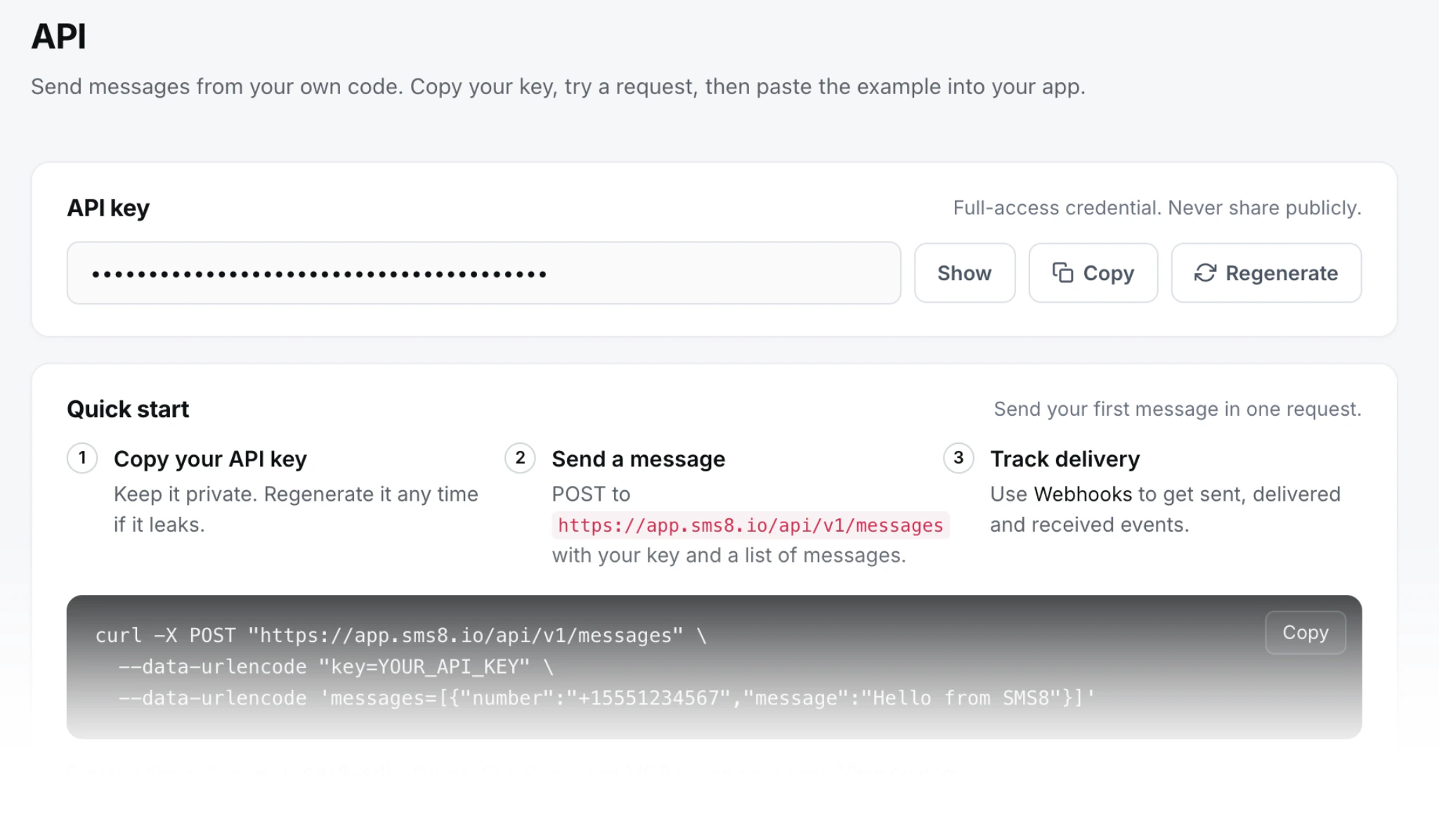
For most use cases, drop-in similar. Twilio uses Basic Auth and a form-urlencoded body; SMS8 uses a JSON body with the API key in the X-Api-Key header. Both return JSON.
Outbound send
# Twilio
curl -X POST "https://api.twilio.com/2010-04-01/Accounts/AC.../Messages.json" \
  -u "AC...:auth_token" \
  --data-urlencode "To=+15551234567" \
  --data-urlencode "From=+15559998888" \
  --data-urlencode "Body=Hello"

# SMS8
curl -X POST "https://app.sms8.io/api/v1/messages" \
  -H "X-Api-Key: YOUR_KEY" \
  -H "Content-Type: application/json" \
  -d '{"number":"+15551234567","message":"Hello"}'
Inbound webhook
# Twilio sends form-urlencoded with x-www-form-urlencoded body
# SMS8 sends JSON with an X-Signature header (sha256= HMAC of the body)
# Both call your webhook URL on every inbound SMS.
If you have an existing Twilio integration the migration is mechanical. Wrap your send function so it dispatches to SMS8 with the same arguments, swap the URL, and run dual-write for a week. The full endpoint list is in the SMS8 API documentation.
What about Twilio Verify for OTPs?
Twilio Verify is billed per verification. At $0.05 per successful verification plus $0.0083 per US SMS (as listed on their Verify pricing page in November 2026) it also adds up fast: 20,000 verifications a month is $1,000 in Verify fees before the SMS charges. On SMS8 the OTP API is part of the plan, and the code goes out on your SIM's mobile plan.
For sign-up, login and "confirm your phone before checkout" flows, see our OTP guide or the SMS8 OTP API reference.
How do Plivo and Telnyx compare?
They keep the same cloud model as Twilio. At the list prices above their base rates are lower, but once carrier fees are added the gap narrows. Both require 10DLC for US traffic, and both still bill per message, plus number rental and campaign fees. SMS8 removes all three: no per-message fee, no number rental and no 10DLC filing, because the text leaves from your own SIM.
How do I actually migrate in a weekend?
The pattern that works:
- Wrap your existing Twilio send call in a function
sendSms($to, $body). Most teams have not done this and have Twilio calls scattered through their code. - Inside
sendSms, dispatch to both Twilio and SMS8 in parallel. Log both responses. Continue using Twilio's success/failure as authoritative. - Run dual-write for 3 to 7 days. Compare delivery rates in your logs.
- Flip the authoritative provider to SMS8. Keep Twilio dual-write on for one more week as a safety net.
- Turn Twilio off. Cancel the account at end of month so the meter stops.
For a single service that already sends through one function, the code change is small; most of the elapsed time is the dual-write week. The savings begin with the first full month.
Twilio vs SMS8 vs the rest: feature matrix
| Feature | Twilio | SMS8 (Android) | Plivo | MessageBird |
|---|---|---|---|---|
| Outbound SMS | Yes | Yes | Yes | Yes |
| Inbound SMS webhook | Yes | Yes (HMAC-signed) | Yes | Yes |
| MMS | Yes | Yes, from your SIM | Yes | Yes |
| OTP/Verify product | Yes ($0.05 per verification) | OTP API, included in the plan | Yes | Yes |
| iMessage from your own Apple ID | No | Yes, from a Mac you own | No | No |
| MCP server for AI agents | No | Yes | No | No |
| 10DLC registration required | Yes | No | Yes | Yes |
| Flat monthly fee | No | Yes (from USD 29) | No | No |
Why SMS8 is the Twilio alternative to try first
- A flat bill: from USD 29 a month, or half that billed yearly, with no per-message fee. See SMS8 plans.
- Your own number: texts leave from the SIM in your phone, so customers see the number they already know.
- No A2P 10DLC filing: person-to-person traffic from your SIM needs no brand or campaign registration.
- The same jobs as an API: REST API, signed webhooks, MMS, an OTP API, iMessage from a Mac you own and an MCP server for AI agents.
- A marketing dashboard too: if you were comparing marketing tools, see SMS8 vs SlickText and the TextMagic and EZ Texting pages linked above.
Setup is physical but short: pair an Android phone, keep it charged and online, and add a second phone when you want more volume or a backup. For reminders, order updates, campaigns and OTP codes, that is a lasting saving on every month that follows.