
Part of the guide Android SMS Gateway App and APK: Unlimited SMS
On this page
- Key takeaways
- What is A2P 10DLC, in one sentence?
- Why did US carriers introduce 10DLC?
- Who actually has to comply?
- How much does A2P 10DLC actually cost?
- What is a "campaign", exactly?
- How long does 10DLC registration take?
- What happens if I do not register?
- How do I legally avoid A2P 10DLC?
- Is sending from my own SIM actually legal?
- P2P vs A2P: where is the actual line?
- What is the actual carrier definition of P2P?
- What is the registration workflow, step by step?
- What is the throughput you get after registration?
- Is 10DLC worth it for a small business?
- What is the equivalent in other countries?
- Why teams switch to SMS8 to skip 10DLC
Key takeaways
- A2P 10DLC is a US carrier-mandated registry, not a federal law. It applies only to cloud SMS providers.
- Cost: a one-time brand fee, a monthly fee per campaign, and carrier surcharges on every message.
- P2P traffic from your own SIM card is not 10DLC. Android phone gateways use this exemption legally.
- Outside the US, 10DLC does not exist. EU, UK, Canada, MENA, LATAM, and APAC senders ignore this entirely.
- Unregistered traffic is filtered and surcharged, often without a clear error.
A2P 10DLC is the US carrier registry that every business texting through a cloud provider on a local number must join, and the way around it is to send person-to-person from your own SIM. It is also the most confused topic in SMS, so this is the long-form, plain-English version. For the sending side, see how an Android SMS gateway sends from your own phone, the complete Android SMS gateway guide, or our Twilio alternatives comparison.
What is A2P 10DLC, in one sentence?
It is a registry, run by US wireless carriers through a company called The Campaign Registry (TCR), that requires any business sending SMS through a cloud provider to register their brand and each messaging campaign before carriers will deliver the traffic reliably.
Why did US carriers introduce 10DLC?
To kill spam. Before 10DLC (pre-2021), any SaaS could spin up a long code at Twilio and blast unsolicited marketing. Carriers responded with aggressive filtering, but that hurt legitimate businesses too. 10DLC was the compromise. Register, get a known-sender reputation, get reliable delivery. The problem is that the registration is friction in places that did not deserve it (small businesses, international startups, sole proprietors), and the spam moved to other channels anyway. Email spammers do not stop because their CPaaS got a registry; they go register, too.
Who actually has to comply?
| Sender | Needs 10DLC? |
|---|---|
| SaaS using Twilio/Plivo/Vonage long codes for US recipients | Yes |
| Sole proprietor using Twilio without an EIN | Sole-prop "low volume" campaign type, yes but reduced fees |
| Business using Twilio short codes only | No (short codes have their own vetting) |
| Business using toll-free numbers only | No (toll-free has its own verification) |
| Sender using an Android-phone gateway (SIM-originated) | No (P2P) |
| EU or UK business sending only to EU recipients | No |
| US business sending only to recipients outside the US | No |
How much does A2P 10DLC actually cost?
| Fee | Amount | Frequency |
|---|---|---|
| Brand registration | $4 | One-time |
| Brand vetting (optional, improves throughput) | Extra one-time fee | One-time |
| Campaign registration | Monthly fee, varies by campaign type | Per campaign |
| Per-message carrier fee (AT&T) | $0.0035 | Per SMS segment |
| Per-message carrier fee (T-Mobile) | $0.0045 | Per SMS segment |
| Per-message carrier fee (Verizon) | $0.0045 | Per SMS segment |
| Unregistered traffic | Extra carrier fees and filtering | Per SMS |
The brand fee is $4 at Twilio; the carrier fees above are as listed by Twilio and Telnyx on their sites in November 2026. Campaign fees depend on the use case and the provider, and a typical small business runs two campaigns (transactional and marketing), each with its own monthly fee on top of the CPaaS bill. The Campaign Registry publishes the fee schedule at campaignregistry.com. Twilio's documentation of how those fees roll into invoices is at twilio.com/docs/messaging/compliance/a2p-10dlc.
What is a "campaign", exactly?
A campaign is a use case grouping. Transactional (order confirmations, OTPs) and marketing (promotions, newsletters) are usually separate campaigns. So is customer-service two-way messaging. Each campaign gets its own monthly fee. The Campaign Registry defines a list of standard and special use-case types, each with its own throughput and price:
| Use case | Throughput tier |
|---|---|
| 2FA / OTP | High |
| Account notifications | Standard |
| Customer care | Standard |
| Delivery notifications | Standard |
| Marketing | Standard |
| Political (election cycle) | Restricted |
| Charity / nonprofit | Standard |
| Low-volume (sole prop, less than 2k/day) | Low |
How long does 10DLC registration take?
If your business is a US LLC or corporation with an EIN, brand registration is instant and campaign vetting takes 1 to 5 business days. If you are a sole proprietor or international company, expect 2 to 4 weeks with multiple back-and-forth requests for proof of consent flow, terms of service, and privacy policy. Companies without a US EIN can get stuck on that step entirely, which is when a SIM-based gateway becomes the practical route.
What happens if I do not register?
Two things, both bad:
- Carriers charge an "unregistered traffic" surcharge on every message (around $0.004 per SMS).
- Carriers filter aggressively, and a large share of messages can silently drop.
You will not get a clean "denied" response. The message will just never arrive. This makes debugging hellish, because your Twilio dashboard shows "delivered" (Twilio's status) but the carrier never relayed it to the handset. The fix is almost always the same: register the campaign and the drops stop.
How do I legally avoid A2P 10DLC?
Four options, in order of practicality:
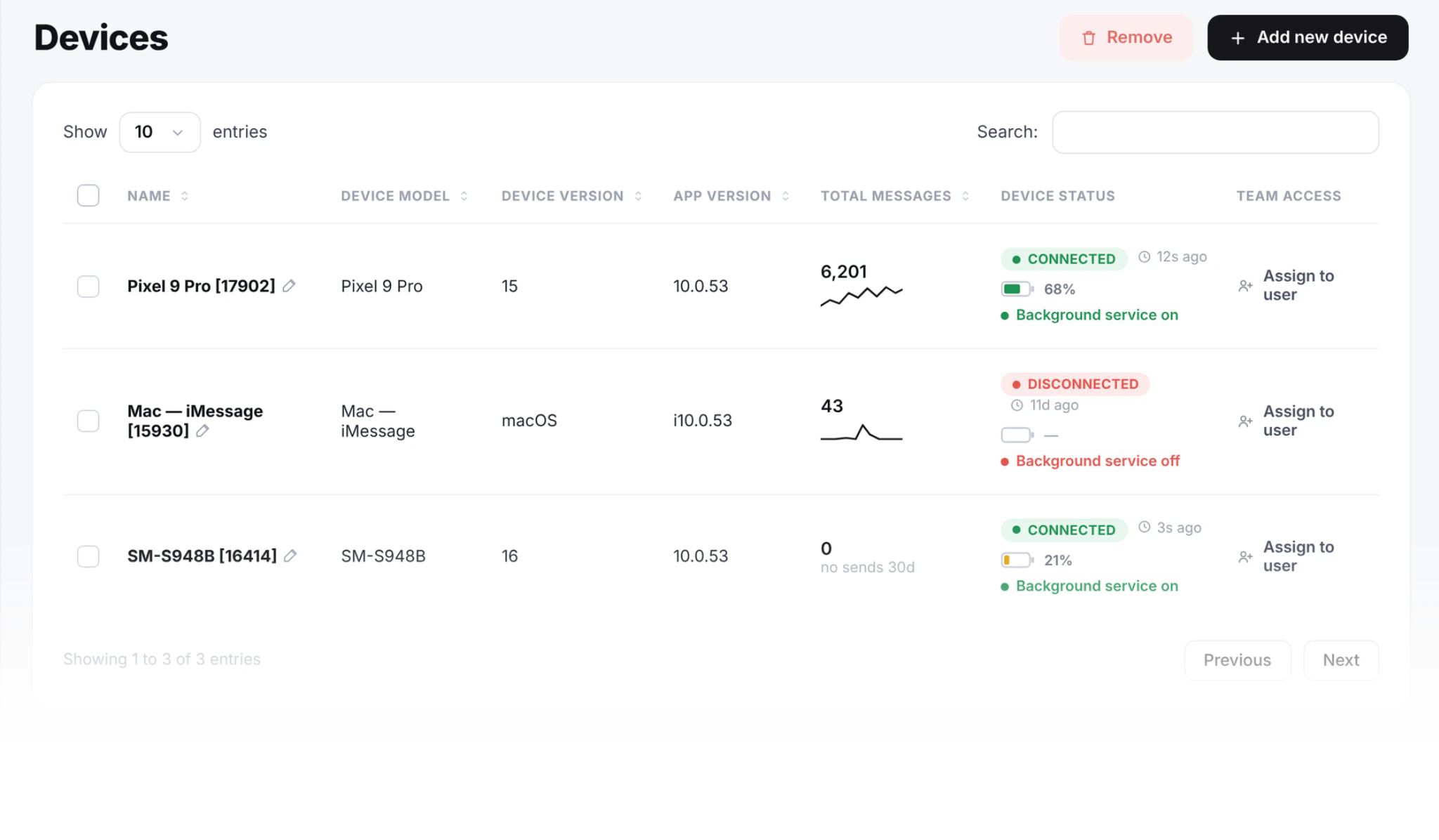
- Send from your own SIM (P2P). Carriers exempt person-to-person SMS from 10DLC because there is no application layer in the middle. An Android phone gateway like SMS8 uses this path. Your SIM is in a phone you physically own; the carrier sees a normal subscriber sending normal SMS.
- Use a US toll-free number. Toll-free has its own (cheaper, simpler) verification process. Throughput is lower (3 messages per second vs higher tiers on 10DLC), but no campaign registry.
- Use short codes. Five-to-six digit numbers, leased for $500 to $1,500 per month plus per-message fees. Better deliverability but expensive and time-consuming to provision.
- Send only outside the US. No other major market has anything like 10DLC. EU, UK, Canada, Australia, MENA, LATAM, APAC all run on local opt-in laws (GDPR, CASL, etc.) but no campaign registry.
Is sending from my own SIM actually legal?
Yes, with two caveats. First, you still have to honor TCPA and CTIA rules in the US, GDPR in the EU, etc. Consent and opt-out are non-negotiable regardless of the technology. Second, your mobile carrier's fair-use clause applies. They will tolerate 500 to 2,000 SMS per day from a normal SIM; beyond that they may suspend the line for spam. The fix is to spread across multiple SIMs, which SMS8's multi-device router does automatically.
The CTIA Messaging Principles cover content rules (no SHAFT without age-gating, no third-party affiliate links, no public URL shorteners) and apply regardless of technology. Read the current edition at ctia.org. I cover the legal side in more depth in how to send bulk SMS from your own phone legally.
P2P vs A2P: where is the actual line?
| P2P (Person-to-Person) | A2P (Application-to-Person) | |
|---|---|---|
| Originating device | Real SIM in a real phone | Cloud API / shortcode |
| 10DLC required? | No | Yes |
| Typical sender | Individual or small business | SaaS, e-commerce platform |
| Volume cap | Carrier fair-use (around 1k/day) | Up to 4k per second (with 10DLC) |
| Delivery model | Local carrier, P2P route | SMS aggregator, A2P route |
| Per-message cost | Your SIM plan (often $0) | $0.005 to $0.015 plus surcharges |
| Sender ID seen by recipient | Real 10-digit number | Long code, toll-free, or short code |
What is the actual carrier definition of P2P?
The CTIA does not publish a hard line. The working definition used by AT&T, T-Mobile, and Verizon (based on their published guidance) is roughly: a SIM-originated message from a subscriber's own line, where the sending rate, content pattern, and recipient set do not look like automated marketing. If your phone sends 50 personalised messages an hour to your customer list, that is normal small-business behaviour. If it tries to send 5,000 identical messages an hour to a purchased list, that is A2P behaviour and the carrier will suspend the line.
The practical rule we tell every SMS8 customer: pace sends at one message every 10 to 30 seconds per SIM (SMS8 campaigns do this for you), vary the content even slightly (first name, order number), and document opt-in for every recipient. There is no 10DLC filing in that setup, because there is no application-to-person route to register.
What is the registration workflow, step by step?
If you do decide to register, here is the actual sequence in 2026:
- Brand registration. Submit your legal business name, EIN, address, and stock symbol if public. The Campaign Registry verifies against IRS records. Cost $4. Result in roughly one hour.
- Optional brand vetting. Pay an extra one-time fee for an enhanced trust score, which can raise the throughput carriers allow. Worth it if you send thousands of messages per day.
- Campaign creation. Pick a use case from the registry's list, write a sample message, paste your opt-in language, link to your privacy policy, and provide a screenshot of your opt-in form.
- Carrier review. AT&T, T-Mobile, and Verizon each review independently. They may approve, ask for changes, or reject. Typical turnaround: 1 to 5 business days. Rejections usually cite "unclear opt-in" or "missing STOP keyword".
- Live traffic. Once all three carriers approve, traffic starts flowing at the assigned throughput tier. Failures pre-approval are silent drops.
What is the throughput you get after registration?
| Trust score / class | T-Mobile messages per second | AT&T daily cap |
|---|---|---|
| Unregistered (penalty) | 0 (filtered) | 0 (filtered) |
| Sole prop low-volume | 1 to 3 | 2,000 |
| Standard brand, low trust | 10 to 25 | 3,000 |
| Standard brand, vetted | 75 to 600 | Unlimited (within carrier policy) |
| Top-tier brand | 2,400+ | Unlimited |
For comparison, a single Android SIM through SMS8 sends campaigns at a steady one message every 10 to 30 seconds, with no registration at all. Each phone or SIM you add raises that rate in step, without the paperwork. For most small businesses that math is the entire decision.
Is 10DLC worth it for a small business?
I think 10DLC is well-intentioned and badly executed. The goal (cut spam) is good. The implementation (a paperwork tax on every legit small business) hurts the wrong people. Spammers get banned, then resurface with a new shell company a week later. Meanwhile, a one-person plumbing business in Ohio gives up on SMS because the registration is too complicated and the campaign types do not fit "I just want to text my customers their appointment time".
We built SMS8 because of this gap. Send person-to-person from your own SIM and skip the bureaucracy entirely: it is legal, it is fast, and your customers see a number they know.
What is the equivalent in other countries?
- UK. No registry. Mobile Marketing Association's Code of Practice applies (consent + opt-out).
- EU. GDPR consent rules. No campaign registry.
- Canada. CASL. Explicit consent required. No campaign registry, but written consent records mandated.
- Australia. Spam Act 2003. No campaign registry.
- India. DLT registration (similar in spirit to 10DLC, mandatory for A2P, free for P2P, run by TRAI through the operator portals).
- UAE / KSA. Operator-level sender-ID approval, no carrier registry like 10DLC, free for SIM-originated.
India's DLT is the closest international cousin, but it is mostly free. The US 10DLC remains the most expensive A2P registry in the world by a wide margin.
Why teams switch to SMS8 to skip 10DLC
SMS8 is the simplest way to text US customers without the registry: your own SIM, one flat plan and no filing.
- No A2P 10DLC filing. Texts go person-to-person from your SIM, so there is no brand, campaign or monthly campaign fee to manage.
- Your own number. Texts leave from the SIM in your own Android phone, so customers see a number they know and can reply to.
- A flat price with unlimited messages. USD 29 a month for one phone or Mac, USD 89 for five and USD 229 for twenty, with unlimited SMS and MMS and no per-message fee. Yearly billing is half the price.
- Setup in minutes. Install the app, pair the phone and copy your API key. The 3-day trial includes 30 messages and needs no card.
- API, MCP and integrations. A REST API with signed webhooks, an MCP server at mcp.sms8.io, and official apps for GoHighLevel, Zapier, Make, WordPress and Google Sheets.
Start the 3-day trial with 30 messages and no card, or compare plans on the SMS8 pricing page.