
Part of the guide Unlimited SMS OTP Sender: Verification API
On this page
Key takeaways
- Twilio Verify charges $0.05 per successful verification plus a channel fee, which is $0.0083 per SMS in the US, as listed on their site in November 2026.
- That makes a US SMS verification $0.0583, so 10,000 sign-ups a month cost about $583 in Verify fees.
- Alternatives include Firebase phone authentication, Vonage Verify, building your own flow on a cloud SMS API, or sending codes from your own Android phone with the SMS8 OTP API.
- SMS8 sends codes from your own SIM with no per-message fee, and handles expiry, attempts, resend waits and a 5-codes-per-number daily cap for you.
- Whatever you choose, the security basics are the same: short expiry, few attempts, rate limits, hashed storage and a fallback channel.
The main alternatives to Twilio Verify for SMS one-time passwords are Firebase phone authentication, Vonage Verify, a do-it-yourself flow on any SMS API, and an OTP API that sends codes from a phone you own, such as SMS8. Twilio Verify is a managed product with fraud protection built in, and it bills $0.05 for every successful verification on top of the SMS itself. If you verify a lot of phone numbers in one country, that platform fee is usually most of the bill. SMS8 removes it: codes leave your own SIM on a flat plan, with no per-message fee and no A2P 10DLC filing.
This article supports our main guide to SMS OTP verification from your own Android phone. Here we look at Twilio Verify's pricing, the options that replace it, a working code example, and the security rules that apply to all of them.
How much does Twilio Verify cost in 2026?
As listed on Twilio's Verify pricing page in November 2026 (the page itself says pricing is current as of October 2026):
- Base fee: $0.05 per successful verification.
- SMS channel fee (US): $0.0083 per SMS, on top of the base fee.
- WhatsApp, voice, email: the same $0.05 base fee plus each channel's own rate.
- Push and TOTP: the channel fee is included in the $0.05 base fee.
- Failed, expired or incomplete verifications: no $0.05 base fee, but the SMS or WhatsApp messages sent along the way may still be billed.
- Fraud Guard: SMS pumping protection is included in the base fee, with no separate charge.
- Volume discounts: custom pricing through sales, which Twilio says is typically evaluated at 100,000 or more verifications a month.
So a successful US SMS verification costs $0.0583 at list price. Worked out from those two numbers, and assuming one SMS per successful verification:
| Successful verifications a month | Base fee ($0.05) | SMS fee ($0.0083) | Twilio Verify total |
|---|---|---|---|
| 1,000 | $50.00 | $8.30 | $58.30 |
| 10,000 | $500.00 | $83.00 | $583.00 |
| 50,000 | $2,500.00 | $415.00 | $2,915.00 |
Resends add SMS fees, and abandoned sign-ups can still cost the SMS fee even though the base fee is waived. The base fee is about 86 percent of each successful verification. Our article on Twilio SMS pricing in 2026 covers the separate Programmable Messaging bill if you also send other texts through Twilio.
What the $0.05 covers
The base fee pays for code generation and checking, which SMS8 also handles for you, with expiry, attempt limits, resend waits and a 5-codes-per-number daily cap included in the plan.
What are the alternatives to Twilio Verify?
1. Firebase phone authentication
If your app already uses Firebase, phone authentication is the shortest path. The Firebase SDKs run the client flow and sign the user in once the code checks out. As listed on the Firebase pricing page in November 2026, phone auth is not available on the no-cost Spark plan; on the pay-as-you-go Blaze plan it is billed per SMS sent, with per-country rates on Google Cloud's Identity Platform pricing page. We could not open that rate page when we checked, so we do not quote a number here.
Watch out for: it ties your user identity to Firebase, and you have less control over the sender and the message wording.
2. Vonage Verify
Vonage Verify is a managed verification API in the same category as Twilio Verify: you ask it to verify a number, it sends the code and checks it, and it supports more than one channel. We could not open Vonage's Verify pricing page when we checked, so we do not quote a number.
Watch out for: the same pricing model as Twilio Verify, with a fee per verification on top of the message.
3. Build your own on a cloud SMS API
You can skip Verify and send codes yourself with Twilio Programmable Messaging, Plivo, Telnyx or another SMS API. You save the per-verification platform fee and pay only per message, but you now own code generation, storage, expiry, attempt limits and abuse protection. In the US you also need A2P 10DLC registration for the sending number. Our post on cloud SMS APIs versus phone gateways compares those providers.
Watch out for: the security details are easy to get wrong. The checklist further down covers them.
4. SMS8 OTP from your own phone
SMS8 sends each code from an Android phone and SIM you own, so the user receives it from a real mobile number, often one they already have saved under your name. SMS8 generates the code, stores it hashed with an expiry, sends it from your paired phone and checks what the user types. There is no per-message fee and, because the text leaves your SIM as a person-to-person message, no A2P 10DLC filing. You pay a flat plan: $29 a month for one connected phone, $89 for five, $229 for twenty, as on our pricing page. Your mobile plan still applies to each text.
Best for: sign-up checks, two-factor login and passwordless login, at any volume where $0.05 per code adds up. Pair a second phone so codes keep flowing if one goes offline, and pair a phone with a local SIM for each country you verify in.
Twilio Verify alternatives compared
| Twilio Verify | Firebase phone auth | Vonage Verify | DIY on SMS API | SMS8 OTP | |
|---|---|---|---|---|---|
| Price model | $0.05 per success + channel fee | Per SMS, Blaze plan | Per verification | Per SMS + number + 10DLC | Flat plan, no per-message fee |
| Code generation and checking | Managed | Managed | Managed | You build it | Managed |
| Sender | Provider's numbers | Provider's numbers | Provider's numbers | Your rented number | Your own SIM |
| Your own message wording | Check provider | Check provider | Check provider | Full | Full, with a {code} placeholder |
How do I send an OTP with the SMS8 API?
Two calls do the whole round trip. First pair an Android phone in the SMS8 dashboard and copy your API key from the API page.
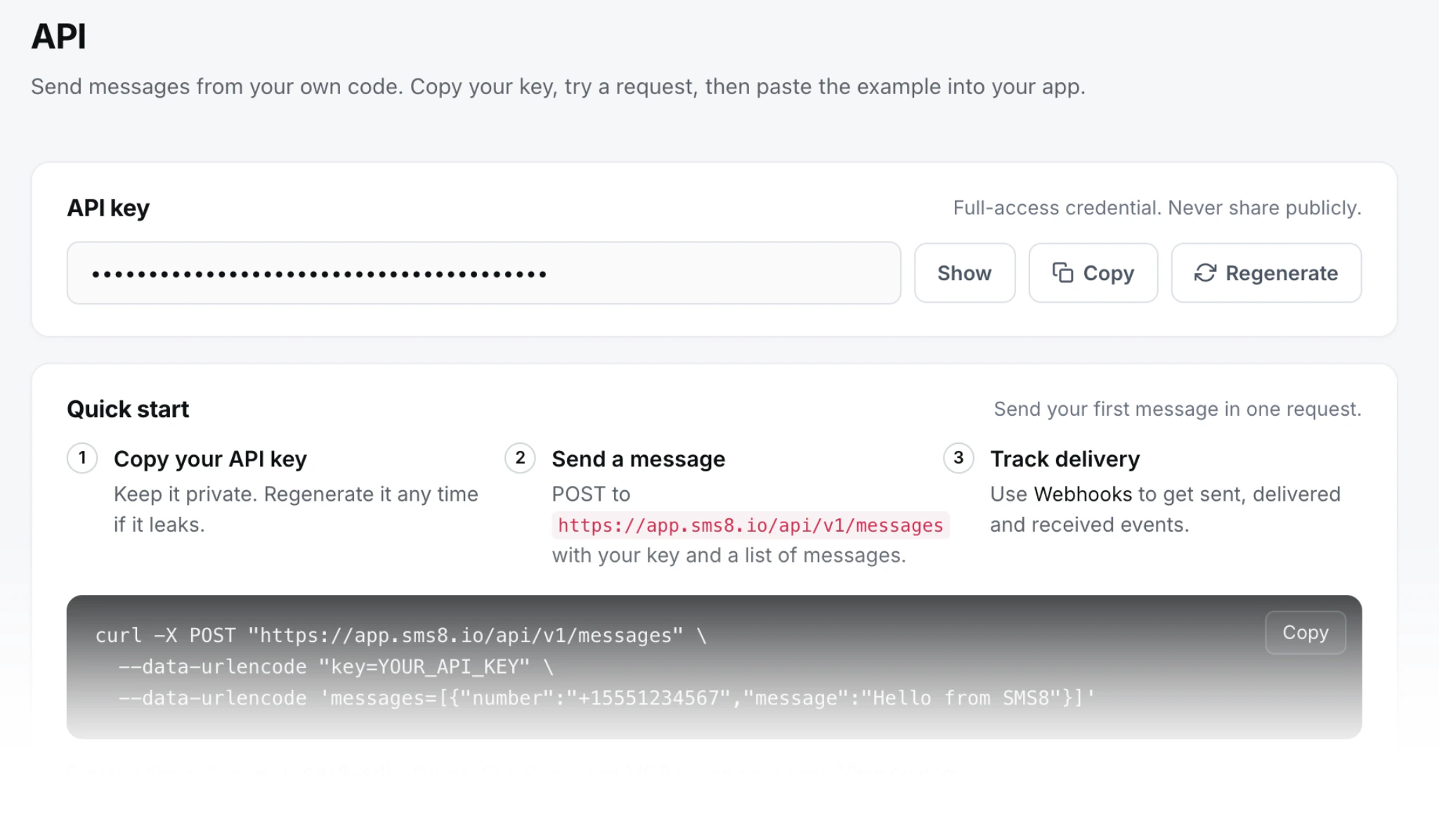
Step 1: send the code. The phone number in international format is the only required field. You can also set the code length (4 to 8 digits, six by default), the expiry in seconds (60 to 900, five minutes by default), the number of tries, and your own wording with a {code} placeholder.
curl -X POST https://app.sms8.io/ajax/otp-send.php \
  -d "api_key=YOUR_API_KEY" \
  -d "phone=+15551234567" \
  -d "length=6" \
  -d "expires_in=300" \
  -d "template=Your Acme code is {code}. Valid 5 min."

# { "success": true, "otp_id": 123, "phone": "+15551234567",
#   "expires_at": "...", "expires_in": 300 }
Step 2: check what the user typed.
curl -X POST https://app.sms8.io/ajax/otp-verify.php \
  -d "api_key=YOUR_API_KEY" \
  -d "phone=+15551234567" \
  -d "code=482917"

# Match:
# { "success": true, "verified": true, "otp_id": 123 }
# No match:
# { "success": true, "verified": false, "reason": "code_mismatch", "attempts_left": 3 }
# Other reasons: "expired", "max_attempts", "not_found"
Here is the same flow from a Node.js server, which is where these calls belong. Never call the OTP endpoints from the browser, because that would expose your API key.
const SMS8_KEY = process.env.SMS8_API_KEY;

async function sms8(path, fields) {
  const res = await fetch(`https://app.sms8.io/ajax/${path}`, {
    method: 'POST',
    headers: { 'Content-Type': 'application/x-www-form-urlencoded' },
    body: new URLSearchParams({ api_key: SMS8_KEY, ...fields }),
  });
  return res.json();
}

// Sign-up form submitted
export async function sendCode(phone) {
  const r = await sms8('otp-send.php', { phone });
  if (!r.success) throw new Error(r.error);
  return r.expires_in;
}

// Confirm screen submitted
export async function checkCode(phone, code) {
  const r = await sms8('otp-verify.php', { phone, code });
  if (r.verified) return { ok: true };
  return { ok: false, reason: r.reason, attemptsLeft: r.attempts_left };
}
Show a clear message for each reason: "That code has expired, send a new one" for expired, and the tries left for code_mismatch. Both endpoints accept POST only and refuse GET requests. If you build with an AI coding assistant, the SMS8 MCP server at https://mcp.sms8.io exposes send_otp and verify_otp tools, so you can describe the flow and let the agent wire it up. In Claude Code: claude mcp add --transport http sms8 https://mcp.sms8.io.
For the full production pattern, including your own storage schema if you want to run the logic yourself, read how to build a real SMS OTP flow with your own Android phone.
What security basics does every OTP flow need?
These apply whether you use Twilio Verify, Firebase, Vonage, your own code or SMS8.
- Six digits, random. Use a cryptographically secure random generator, never a timestamp or a counter. Six digits give a million combinations, which is safe when combined with attempt limits.
- Short expiry. Five minutes is a good default. Long-lived codes give an attacker more time to guess or intercept.
- Few attempts. Lock the code after a handful of wrong tries and make the user request a new one.
- Hash the code at rest. Store a hash, not the digits, so a database leak does not expose live codes. Compare in constant time so response times reveal nothing. SMS8 does both.
- Rate-limit sends. Limit codes per phone number and per IP address, and add a resend wait. SMS8 enforces a resend wait you choose (30 seconds to 10 minutes) and a fixed cap of 5 codes per number in 24 hours, checked inside a locked database step so parallel requests cannot slip extra codes through.
- Protect the send endpoint. Put a captcha or similar check in front of any unauthenticated "send code" form. Bots that hammer it can flood a victim with texts or, on per-message providers, run up your bill through SMS pumping. Restrict the countries you accept numbers from if you only serve a few.
- Say what the code is for. "Code to change your email: 482917" makes it harder to trick a user into reading out a code for a different action.
- No links in the code message. Links invite look-alike phishing texts.
- Have a fallback. SMS can fail when a user has no signal or just changed numbers. Offer email or an authenticator app as a second path.
SMS is a good, low-friction check for most consumer apps, but it is not the strongest second factor. For high-value accounts, offer an authenticator app or passkeys and keep SMS as a fallback. Our checklist of phone number verification best practices goes deeper on number checks, SIM swap risks and recovery.
Why teams switch their OTP to SMS8
- No fee per code. One flat plan from $29 a month, or half that billed yearly, instead of $0.05 per verification plus the SMS.
- Codes from your own number. Users get the code from a real mobile number, often one they already have saved under your name.
- No A2P 10DLC filing. Codes leave your SIM as person-to-person texts, so there is no brand or campaign to register.
- The OTP logic is done for you. Send and verify in two calls, with hashed codes, expiry, attempt limits, resend waits and a daily cap per number.
- Codes jump the queue. Codes can be sent ahead of other traffic, so they arrive first even while a campaign is going out.
- Minutes to set up. Pair an Android phone, copy your API key and try it on the 3-day trial with 30 messages, no card needed.
For the wider picture of moving off Twilio, see our Twilio vs SMS8 comparison.