
Part of the guide Twilio Alternatives 2026: Cheaper SMS APIs Compared
On this page
- Key takeaways
- What does Twilio cost for SMS in Europe?
- Which European SMS providers can you check today?
- How do the options compare?
- Is there A2P 10DLC in Europe?
- What are the sender ID rules in Europe?
- What does GDPR mean for an SMS provider, in plain words?
- What is the own-SIM option, and when does it fit?
- Why small European businesses switch to SMS8
- How to move from Twilio to your own SIM in an afternoon
Key takeaways
- Twilio lists $0.1143 per outbound SMS segment to the Netherlands, plus $7.70 a month for a Dutch mobile number, as listed on their site in November 2026.
- GatewayAPI, built in Denmark, publishes a full price list: EUR 0.0669 per SMS to the Netherlands on its standard route, and lower rates for France and the UK.
- CM.com (founded in Breda, Netherlands), Bird, Sinch and Vonage are the other names most European teams shortlist. Their EU rates sit behind a country selector or a sales form, so compare them on your own destinations.
- There is no A2P 10DLC in Europe. What you deal with instead is sender ID rules per country, consent rules under the ePrivacy framework, and GDPR for the phone numbers you store.
- For a small business texting customers in one country, sending from your own SIM with a flat plan such as SMS8 at USD 29 a month often costs less than any per-message provider.
The best Twilio alternative in Europe for a small business that texts its own customers is a SIM you already own. With SMS8 there is no per-message fee, and customers see a mobile number they know and can reply to. If you are also looking at per-message providers, this article lists what GatewayAPI, CM.com, Bird, Sinch and Vonage publish, with prices taken only from each provider's own pages, opened on 16 November 2026.
This post is part of our wider guide to the best Twilio alternatives for 2026, which covers US-focused providers like Plivo and Telnyx. Here we stay in Europe, with the Netherlands as the main example because that is where many of the searches come from.
What does Twilio cost for SMS in Europe?
Twilio prices Europe per country, and the rates are much higher than in the US. As listed on Twilio's Netherlands SMS pricing page in November 2026:
- Outbound SMS to the Netherlands: $0.1143 per message segment, whether you send from a number or an alphanumeric sender ID.
- A Dutch mobile number leased from Twilio: $7.70 a month.
- A failed message processing fee of $0.001 for messages that end in a Failed status, and carrier fees that may also apply.
Twilio bills per segment, so a 200-character message is two segments and costs twice as much. A message with an emoji switches to a smaller segment size, which can make it three. Our free SMS character counter shows the segment count before you send. If you want the full Twilio price sheet for the US, read Twilio SMS pricing in 2026, line by line.
At $0.1143 per segment, 2,000 one-segment texts a month to Dutch numbers cost $228.60, plus $7.70 for the number, or $236.30 before VAT. That is the number most small businesses in the Netherlands are trying to beat when they search for an alternative.
Which European SMS providers can you check today?
We opened the pricing page of each provider below on 16 November 2026. Where a page shows a number, we quote it. Where the page hides EU rates behind a selector or a sales form, we say so instead of guessing.
GatewayAPI (Denmark)
GatewayAPI is a Danish SMS API priced per message and per destination country.
GatewayAPI publishes its full SMS price list, which feeds the country table on its pricing page. As listed on their site in November 2026, per SMS:
| Destination | Standard route | Premium route |
|---|---|---|
| Netherlands | EUR 0.0669 | EUR 0.0739 |
| Belgium | EUR 0.0696 | EUR 0.0736 |
| Germany | EUR 0.0722 | EUR 0.0764 |
| France | EUR 0.0428 | EUR 0.0475 |
| United Kingdom | EUR 0.0378 | EUR 0.0418 |
For 2,000 texts a month to Dutch numbers on the standard route, the bill is EUR 133.80, and it grows with every text you add.
CM.com (Netherlands)
CM.com is a Dutch company based in Breda. Its SMS pricing page describes a pay-per-use model with one price per SMS per country. The country rates load through an interactive selector, and we could not read a Dutch rate from the page when we opened it, so we do not quote one here.
Bird, formerly MessageBird
Bird's SMS pricing page shows US rates by default, such as $0.0035 per outbound US long code segment, as listed on their site in November 2026. It did not show European per-country rates in the version we could read. Bird's privacy notice names Bird.com Inc. as its entity under the EU-US Data Privacy Framework and says its services may involve transferring personal data to recipients inside and outside the European Economic Area. If data location is part of your decision, ask Bird which entity you contract with and where your message data is processed before you sign.
Sinch
Sinch lists an EMEA office in Stockholm, Sweden, on its about page. Its SMS pricing page shows US and Canada rates, and the European rates did not load in the version we could read. For a small business, the main thing to check is whether you can buy at list price without a sales call.
Vonage
Vonage's SMS pricing page refused our request when we tried to open it on 16 November 2026, so we give no figure. Vonage sells per-message SMS to European countries through its API platform.
How do the options compare?
| Twilio | GatewayAPI | CM.com | SMS8 (own SIM) | |
|---|---|---|---|---|
| SMS to the Netherlands | $0.1143 per segment | EUR 0.0669 standard | Per country, see their selector | Your mobile plan's rate, often included |
| Monthly fee | $7.70 for a Dutch mobile number | None listed | None, per their page | USD 29 for one phone |
| Sender people see | A rented number or a sender name | A sender name or number | A sender name or number | Your own mobile number |
| Two-way replies | Yes, on a number | Yes, on a number | Yes, on a number | Yes, to your own number |
Prices for Twilio and GatewayAPI are as listed on their sites in November 2026. Rates change with carrier costs.
Is there A2P 10DLC in Europe?
No. A2P 10DLC is a US system run by US carriers and The Campaign Registry. It applies to business texts sent to US numbers from ordinary 10-digit US numbers through a cloud platform. If your customers are in the Netherlands, Belgium, Germany or France, you do not file a 10DLC brand or campaign. If you also text US customers, the US rules still apply to that traffic, and our guide to A2P 10DLC and how to avoid it explains what changes.
Europe has its own set of rules instead. They are less about registering campaigns and more about who the sender is, when you text, and whether the person agreed to it.
What are the sender ID rules in Europe?
A sender ID is what the recipient sees in the "from" field. In Europe it is usually one of two things: a phone number, which people can reply to, or an alphanumeric sender ID, a short brand name such as "ACME" that cannot receive replies. The rules differ by country. Two examples from Twilio's country guidelines, as listed on their site in November 2026:
- Netherlands. Twilio's Netherlands guidelines say alphanumeric sender IDs do not need pre-registration, two-way SMS is supported, and short codes are not supported by Dutch operators. They also advise sending during the recipient's daytime hours and supporting STOP-style replies in Dutch.
- France. Twilio's France guidelines say business (A2P) messages must use an alphanumeric sender ID, international numbers as senders are not supported, and marketing texts may only go out from 08:00 to 21:30 local time, Monday to Saturday. Transactional texts such as OTPs and delivery updates are exempt from that window.
The practical lesson: if you text several European countries from one cloud account, you need to check the rules for each destination.
What does GDPR mean for an SMS provider, in plain words?
GDPR is about the personal data you hold, and a phone number is personal data. When you send texts through a provider, the provider handles those numbers and the message content on your behalf. In plain terms, that means four things for a small business:
- You need a reason to hold the number. For a customer who gave you their number to get appointment reminders, that reason is clear. For a bought list, it is not.
- You need a contract with the provider. This is usually called a data processing agreement. Most providers offer a standard one. Ask for it before you send real customer data.
- You should know where the data goes. If the provider stores or processes data outside the EU, the transfer needs a legal basis, such as the EU-US Data Privacy Framework that Bird refers to in its privacy notice.
- You keep only what you need. Delete numbers of people who opted out of everything, and do not keep message logs forever if you have no reason to.
Marketing texts also fall under the ePrivacy rules that each EU country writes into its own law. In most cases they require prior consent for marketing SMS, with a narrow exception in many countries for existing customers who bought something similar and were given an easy way to opt out. This applies whichever provider you use, including your own phone. When in doubt, ask for consent and keep a record of it.
What is the own-SIM option, and when does it fit?
Instead of buying texts from a provider, you can send them from a mobile phone with a SIM you already pay for. SMS8 works this way: you pair an Android phone (Android 7 or newer) with the SMS8 app, and your texts, campaigns, API calls and integrations send through that phone's SIM. Your customers see your real mobile number and can reply to it. Replies land in a shared web inbox.
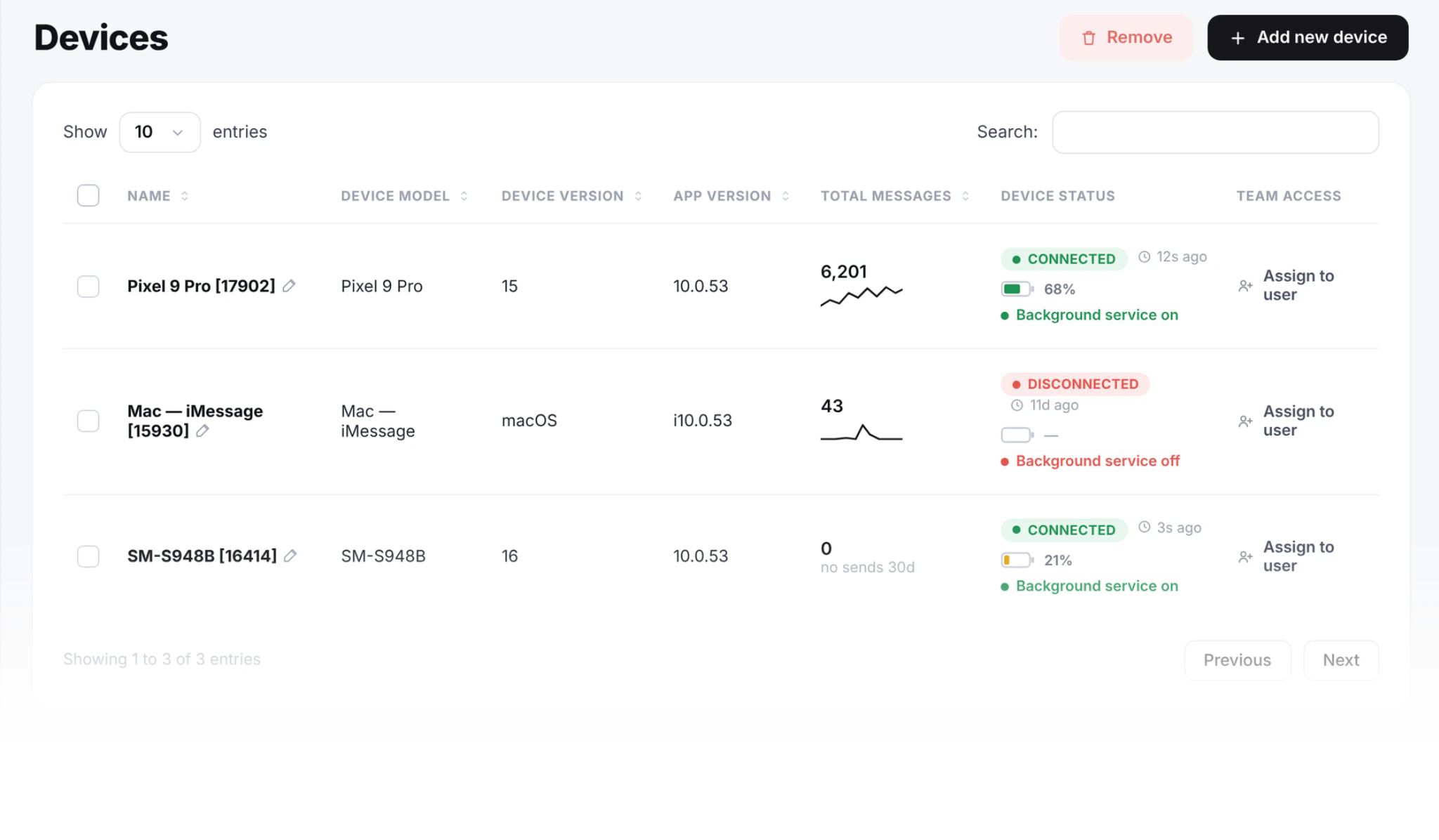
SMS8 adds no per-message fee. You pay a flat plan, as listed on our pricing page: USD 29 a month for one connected phone, USD 89 for five, and USD 229 for twenty, with unlimited SMS and MMS. Yearly billing costs half the monthly price. The cost of each text is whatever your mobile plan charges, and many Dutch, Belgian and German mobile plans include unlimited or high-allowance SMS. Check your plan's fair-use terms before you run large campaigns on it.
Back to the 2,000 Dutch texts a month example:
| Option | Monthly cost for 2,000 one-segment texts to Dutch numbers |
|---|---|
| Twilio | $228.60 in messages plus $7.70 for a number, $236.30 |
| GatewayAPI, standard route | EUR 133.80 |
| SMS8 with your own SIM | USD 29 (or USD 14.50 a month billed yearly), plus your mobile plan |
Run your own volume through our free SMS cost calculator to see where the lines cross for your business.
What to know before you switch to your own SIM
- Your number as sender. Your texts come from your mobile number. For a salon, a clinic, a plumber or a local shop, that is an advantage, because customers already know the number and can reply to it.
- Pacing. SMS8 sends bulk campaigns at one message every 10 to 30 seconds per SIM, so a SIM keeps looking like a normal phone to the carrier. That is a few thousand texts in a full day per SIM. For more, add phones.
- Hosting. Your texts travel over your own carrier, but your message history and inbox live in the SMS8 web dashboard. Read our privacy policy to see where it is kept, and ask us any question.
- Cross-border texting. A Dutch SIM texting German numbers pays whatever your carrier charges for international SMS. Some businesses pair one phone per country, each with a local SIM.
Our article on sending bulk SMS from your own phone legally covers consent, opt-outs and pacing in more depth, and the comparison of cloud SMS APIs and phone gateways explains the trade-offs from the technical side.
Why small European businesses switch to SMS8
- A fixed monthly cost: USD 29 a month for one phone, or USD 14.50 billed yearly, with no per-message fee from SMS8.
- A number customers know: texts and replies run on your own mobile number, so conversations, reminders and follow-ups get answered.
- No sender registration on your own number: there is no A2P 10DLC in Europe, and your SIM sends like any phone.
- One account for several countries: pair one phone per country, each with a local SIM, and run them from one dashboard.
- Quick to try: a 3-day trial that includes 30 messages and needs no card.
How to move from Twilio to your own SIM in an afternoon
- Create an SMS8 account and start the trial. Install the Android app on a phone with Android 7 or newer, put in your business SIM and pair it by scanning the code on your dashboard.
- Turn off battery optimisation for the SMS8 app on that phone, keep it on a charger and on Wi-Fi.
- Replace your Twilio send call with
POST https://app.sms8.io/api/v1/messages, with your API key in theX-Api-Keyheader. The SMS8 API documentation lists every field. - Point reply handling at SMS8 webhooks, which are signed and retried for up to 30 days. If you use Zapier, Make, GoHighLevel, WordPress or Google Sheets, use the official SMS8 app for that tool instead of code.
- Send to a small group first, check replies arrive, then move the rest of your traffic and cancel the Twilio number.
Our Twilio vs SMS8 comparison goes line by line, and the Android SMS gateway page explains how the phone side works.