
Part of the guide SMS Marketing Campaigns From Your Own Phone
On this page
The short version
SMS marketing in 2026 is not the same channel it was three years ago. Open rates are still excellent (98% within 3 minutes), but list fatigue is real. The brands winning are the ones treating SMS as a precision instrument: tight segments, short copy, perfect timing, and ruthlessly honest unsubscribe paths. This guide walks through 12 plays that convert, with copy templates you can adapt directly, all of which you can run from SMS8 SMS marketing campaigns on an in-house Android SMS gateway. For the basics of list building, throughput and cost, start with the bulk SMS marketing guide; to measure results, see SMS marketing ROI. Every play here runs on SMS8 from your own number, with no per-message fee eating into the margin.
Why SMS still works, and where it stops working
The case for SMS marketing in 2026 hasn't changed structurally since 2020: a text message sits in the same inbox as messages from a recipient's mother, their bank, and their dentist. That context demands respect, and respect is rewarded. The average promotional email gets opened by 21% of recipients within the first day. The average promotional SMS gets opened by 95% of recipients within 3 minutes. That gap has narrowed slightly as inbox fatigue spreads to SMS too, but it remains the largest open-rate disparity of any owned channel.
What has changed is the cost of getting it wrong. In 2021 you could send weekly broadcast SMS to your entire list and most people would tolerate it. In 2026 they will unsubscribe within two messages and tell a friend you spam. The brands winning now have stopped sending campaigns and started sending replies, to a specific person, about a specific moment.
The pattern is easy to see in your own numbers: whole-list broadcasts sent several times a month pull far higher unsubscribe rates than behavior-triggered messages, on the same channel, with the same product, often with the same copy. The variable is who gets the message and why.
The 12 plays
What follows is the working set. Each play has three parts: who it targets, what the trigger is, and what to write. The copy templates are starting points, not laws, your voice will be different from ours, and that difference is good.
1. Abandoned cart, single-send, 47-minute delay
The classic play, often executed poorly. Most brands send the abandoned cart SMS immediately, within five minutes of the cart being abandoned. That is too soon, the person is often still browsing, sometimes still on your site. They will see the SMS as evidence you are watching them, which is uncomfortable, and they will perceive your discount as desperation.
Wait 47 minutes. The number isn't magic, but it is long enough that the cart abandonment feels resolved from the customer's side, and short enough that the items are still relevant. The single most important rule is to send only one message. Two SMS for a single cart is the fastest unsubscribe path we measure.
"Hi {firstName}, your {itemName} is still in your cart at {storeName}. Here it is again: {shortLink}. If you're done, just reply STOP."
Note three things in that template. We name the specific item (not "your items"), we include a STOP path in the body (not just the legal footer), and the link is the cart itself, not the homepage. Brands that link to the cart see 2-3x the conversion of brands that link to a coupon page that requires another click.
2. Back-in-stock, time-of-restock send
The highest-converting play in this guide. Conversion rates between 12% and 25% are typical, because the audience is self-selecting: they explicitly asked to be notified when the item came back. The mistake brands make is queueing all back-in-stock notifications for a daily 11am send. Send the instant the inventory updates.
Hook this to your inventory webhook, not a scheduled cron. If you're using n8n for automations, the recipe is: Shopify product update webhook → check if previously zero → check who subscribed to back-in-stock → loop through subscribers → SMS each via SMS8 API.
"Good news {firstName}, the {itemName} you wanted is back. Grab it before it goes again: {shortLink}"
3. Price drop on a viewed item, single-send
If a customer viewed a product within the last 14 days and you reduce the price by more than 10%, that's a moment. Most brands don't track product views with enough fidelity to do this, which is why it works, your competitors have the same data and aren't using it.
The mechanics: you need a product-view event log keyed by phone number (or by an internal customer ID joined to phone). When a SKU drops in price, query for all customers who viewed it in the last 14 days but didn't buy, send them an SMS with the new price.
"{firstName}, the {itemName} you were looking at last week just dropped to ${newPrice} from ${oldPrice}. {shortLink}"
4. Win-back at 60 days dormant, two-message sequence
Two messages, 5 days apart. The first acknowledges absence and offers nothing. The second introduces a specific incentive. The reason to split it is data: the first message segments your list into "responds" and "doesn't respond," which is more useful than any heuristic you could write.
Message 1 (day 60 of dormancy):
"Hey {firstName}, it's been a while. Just curious, anything we could be doing better? Reply and let us know."
Message 2 (day 65, only if no reply to message 1):
"Hi {firstName}, here's 20% off your next order, just for being part of the {storeName} family for over a year. Code: BACK20 → {shortLink}"
The replies to the first message are gold. Those replies are the highest-quality customer feedback you will ever get, because the customer is currently choosing to leave you. Read every one personally.
5. Post-purchase delivery anchor
SMS at delivery is your second-highest engagement window after the order confirmation itself. The play is not to confirm delivery (the carrier already did) but to anchor the moment of unboxing to your brand. Send a single message 2 hours after delivery confirmation.
"{firstName}, your {productName} should be in your hands. We'd love to see it, tag {socialHandle} if you share. Reply ENJOY for a small thanks. ❤️"
The "reply ENJOY for a small thanks" trick is doing real work. People who reply opt themselves into a small follow-up incentive (a free shipping code for their next order, usually) and you've now confirmed they're satisfied, they wouldn't have replied otherwise. Reply rates here run 8-12%.
6. VIP early access, 24-hour window
Segment your top 10% of customers by lifetime value. Before any sale or new product drop, give them 24 hours of early access with an SMS. This is the only "broadcast" SMS you should be sending; everything else should be triggered.
"{firstName}, VIP early access. The {launchName} is live for you 24 hours before everyone else. Shop now: {shortLink}"
The lift versus letting the same customers find out via the public launch email is usually clear in a simple A/B split. The reason is partly the time advantage but mostly the feeling of being chosen, which the SMS channel communicates more strongly than email.
7. Geo-trigger for in-store visits
If you have physical retail and you're not running this play, you are leaving money on the table. The trigger: customer's last known coordinates (via your app, your Shopify POS check-in, or a third-party data source) is within 1km of a store location.
This play can convert very well, because the message arrives when the customer is nearby. The catch: you need a clean opt-in flow for location sharing. Most merchants don't, which is why this play has a long head-start window for those who do it right.
"{firstName}, you're near our {storeName} location. Stop by and we'll throw in a free {smallItem} with your purchase today. See you soon."
8. Browse abandonment, longer wait
Different from cart abandonment. The customer browsed three or more product pages in a single session but never added to cart. The play here is informational, not promotional, they were researching, so help them research.
Wait 6 hours, then send a curated comparison link, not a discount. The conversion isn't to a purchase that day; it's to a return visit. Click-through on these messages tends to be strong, and the customers who return convert 2.5x better than first-time visitors.
"{firstName}, saw you were comparing {category} earlier. Here's our 60-second guide to picking the right one: {shortLink}"
9. Birthday / anniversary, 48 hours early
Send 2 days before the date, not on the day. The day itself is crowded with every other brand who has the same data. 48 hours early stands out and gives the recipient time to use whatever you're offering. Conversion rates jump from 3-5% (day-of) to 6-9% (two days before).
"Hi {firstName}, your birthday is in 2 days. Here's a little something from {storeName}: {birthdayCode}, good for 20% off any order. Happy early birthday 🎂"
10. Subscription renewal warning, T-7 days
For any subscription product, an SMS 7 days before renewal that doesn't link to cancel, it links to update preferences. The framing matters: "you can swap, skip, or pause" reads very differently from "you'll be charged in 7 days."
"Hi {firstName}, your {subscriptionName} renews on {renewDate}. Want to swap, skip, or pause? Manage here: {shortLink}"
11. Re-engagement after 90 days, one shot
Distinct from win-back (60 days). At 90 days dormant, you've lost most of them, but the ones who do respond are usually significant. Make one strong offer, never follow up.
"{firstName}, we miss you. Here's 30% off anything, no strings. {shortLink}. After this, we'll quietly remove you from our list. Thanks for being part of {storeName}."
The "we'll quietly remove you" line is honest list hygiene communicated as respect. It works: a share of dormant subscribers come back, and the ones who don't respond get unsubscribed automatically, saving you cost and improving deliverability.
12. Two-way reply automation
The most underused play. Every other tactic above sends one-way. This one uses your incoming SMS pipeline to read replies and route them. A customer replies "what's the return policy", your system detects the question, sends the policy via SMS, and routes the conversation to a human if escalated.
Built right, this is your highest-converting channel by a margin: people who text in are pre-qualified. The infrastructure is straightforward: webhook on incoming SMS → keyword match or LLM intent classification → templated SMS reply or human handoff. The Claude Code MCP tutorial walks through one specific implementation using LLM intent routing.
Send-time rules across the playbook
Across all 12 plays, four send-time rules consistently hold:
| Rule | Effect |
|---|---|
| Tuesday to Thursday 10am to 2pm local time | A good default window to test against |
| Never before 9am or after 9pm local time | US TCPA rules bar marketing texts before 8am and after 9pm, and some states are stricter; 9am gives a margin |
| Avoid Sunday before noon | Tends to draw more unsubscribes; test it on your own list |
| Wait at least 6 hours between any two SMS to the same person | Fewer unsubscribes, with little loss of conversion |
"Local time" is doing a lot of work in that table. If you can't reliably resolve the recipient's timezone (from explicit signup, from geo-IP at signup, from order shipping address), you should default to recipient's last-known timezone or, failing that, your home market's evening hours, which are the safest universal window.
Segmentation logic that actually moves the needle
Most SMS marketing failures are segmentation failures. Brands talk about segments but operationally send to "all subscribers" or "all subscribers who haven't unsubscribed." Those are not segments. Real segmentation looks like this:
| Segment | Definition | Send cadence |
|---|---|---|
| VIP | Top 10% by LTV, last purchase within 60 days | 4 to 6/month, mostly behavioral + early access |
| Active | 1+ purchase in last 90 days, not in VIP | 3 to 5/month, mix of behavioral and broad |
| Drifting | Last purchase 60 to 120 days ago | 1 to 2/month, mostly win-back sequences |
| Dormant | 120+ days since last purchase | 1 single re-engagement, then quiet |
| New (no purchase) | Opted in within last 30 days, no purchase | 2 to 3/month, mostly informational + 1 strong offer |
| One-time buyer | Exactly 1 purchase, more than 30 days ago | 3/month, focused on second-purchase plays |
Note that the heaviest cadence goes to your VIPs, not your cold list. This is counter-intuitive to many marketers who treat SMS as a paid-acquisition channel. SMS is not acquisition; SMS is retention and reactivation. Acquire elsewhere.
Compliance: the part everyone gets wrong
Three rules you can't skip in 2026, regardless of jurisdiction:
- Explicit opt-in for marketing. Not "by purchasing, you agree to receive marketing SMS." That's not consent in the US, UK, EU, Canada, or Australia. The legal phrasing varies but it means an unchecked checkbox or an explicit reply opt-in keyword. The buried language at checkout doesn't count.
- STOP must work, and within one message. You can't make the customer go through a form. Reply STOP → immediate unsubscribe → confirmation message → silence. If you don't honor STOP within 10 minutes, you're exposed legally and operationally.
- Identify yourself in every message. Your brand name must appear in every SMS, not just the first one. "Hey, 30% off, code SUMMER", illegal in most jurisdictions because there's no "from {brand}".
If you're using your own Android phone as the gateway, the legal framing is generally more favorable than using a managed bulk SMS provider, because P2P (person-to-person) messaging from a real mobile number falls under different rules than A2P (application-to-person). The US TCPA still applies, but the more restrictive A2P 10DLC registration requirements typically do not.
What this means for you
The point is that the cost of running SMS marketing has compressed dramatically in 2026, between Android-phone-based gateways, open-source automation tools like n8n, and segmentation logic that any competent marketer can build, to the point where the operational leverage tilts heavily toward in-house infrastructure.
Three years ago, building an SMS marketing stack required either expensive vendor software or a senior engineer. In 2026, a marketing team of two can run a sophisticated SMS program end to end. The tactical playbook above hasn't fundamentally changed; what changed is the access. The barriers to running marketing-grade SMS have collapsed.
If you're starting from zero, the order of operations is: get the gateway running first (an afternoon), connect it to your e-commerce platform (a day), launch plays 1 and 5 (a week), then add the rest as you measure. Don't try to deploy all 12 at once. The merchants who win are the ones who launch a play, measure for 14 days, then add the next.
The next 60 days
If you're going to act on this guide, here's what to do this week and next:
This week: Pair an Android phone with SMS8 (setup guide), or start the 3-day trial with 30 messages (no card) to test it on your existing phone. Wire up one play, pick abandoned cart, it's the highest-leverage starting point. Run it for 14 days against your current setup.
Next 30 days: Add plays 5 (post-purchase) and 9 (birthday), the lowest-effort additions. Build the segment definitions in a SQL view or Airtable, even if you can't yet enforce cadence caps. Just having the segments visible changes how you think.
Next 60 days: The bigger plays, VIP early access (6), win-back (4), and two-way replies (12). These require more thought but produce most of the long-term LTV gain. Plan to spend a half-day per play on copy, trigger logic, and measurement setup.
By day 60 you will be running a more sophisticated SMS marketing program than 90% of the e-commerce brands competing with you. The remaining edge will be specific copy and segment refinement, which only your own list can teach you.
Why choose SMS8 to run these plays
SMS8 runs all 12 plays from your own number on one flat plan.
- Your own number. Texts leave from the SIM in your own Android phone, so customers see a number they know and can reply to.
- A flat price with unlimited messages. USD 29 a month for one phone or Mac, USD 89 for five and USD 229 for twenty, with unlimited SMS and MMS and no per-message fee. Yearly billing is half the price.
- No A2P 10DLC filing. Texts go person-to-person from your SIM, so there is no brand, campaign or monthly campaign fee to manage.
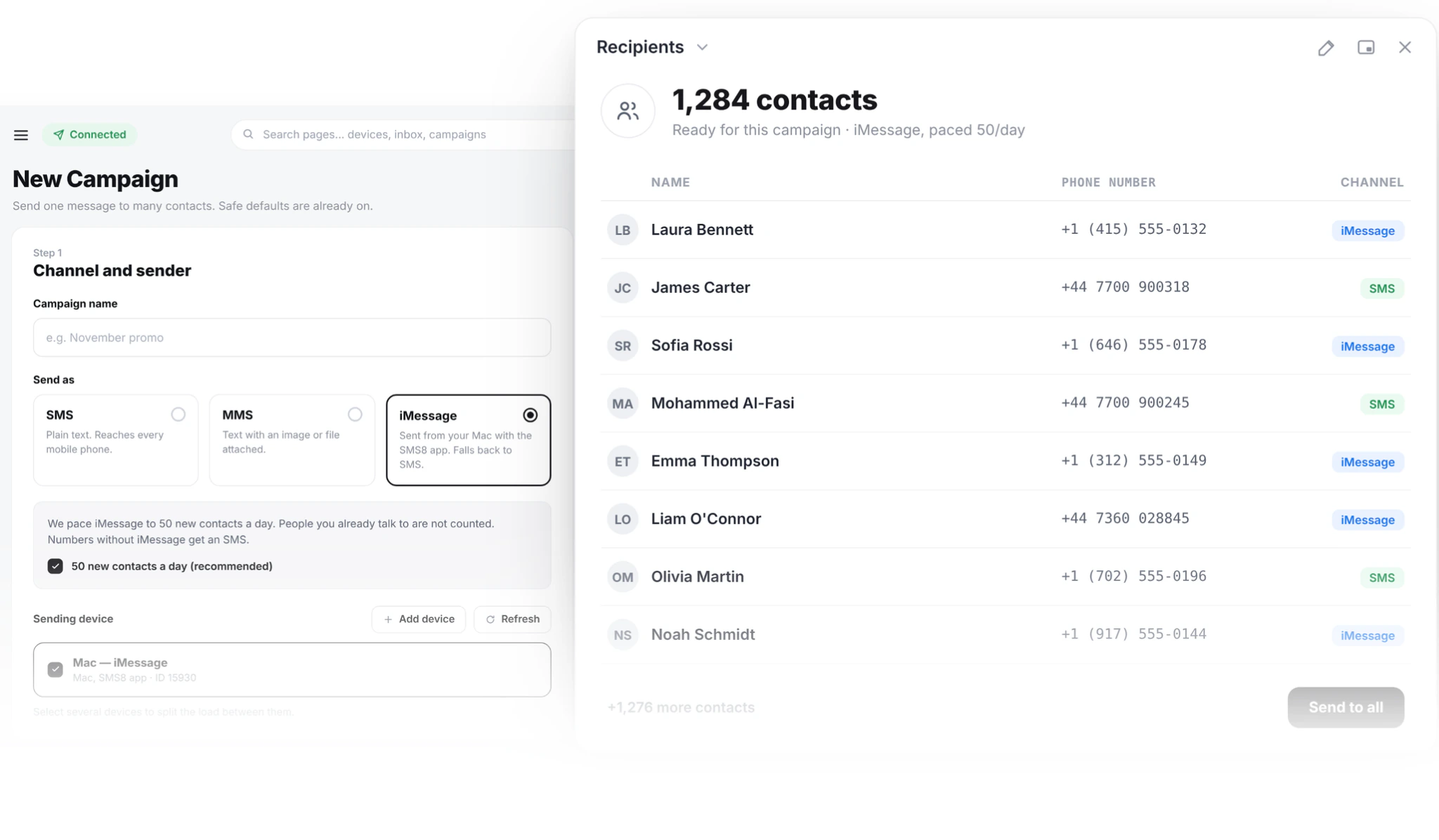
- SMS, MMS and iMessage in one inbox. Pair Android phones for SMS and MMS and a Mac for iMessage with SMS fallback, then answer everything from one shared inbox.
- Automations without code. Official Zapier and Make apps, an n8n HTTP Request node recipe, and a Google Sheets add-on all send through the same phone.
- Setup in minutes. Install the app, pair the phone and copy your API key. The 3-day trial includes 30 messages and needs no card.
Start the 3-day trial with 30 messages and no card, or compare plans on the SMS8 pricing page.