
Part of the guide SMS Marketing Campaigns From Your Own Phone
On this page
- From CSV to first bulk send in 10 minutes
- The short version
- What "bulk SMS" actually means in 2026
- Delivery model: virtual number vs paired phone
- List quality is upstream of everything
- The six campaign patterns worth shipping
- Deliverability, in the parts that actually matter
- Compliance basics: what regulators actually enforce
- Cost, with a real example
- Measurement: three metrics, not thirty
- Getting started: what to build this week
- Why choose SMS8 for bulk SMS marketing
From CSV to first bulk send in 10 minutes
One paired Android, one CSV, one composer. Real sender ID, replies threaded, STOP handling automatic. The campaign tools live in SMS8 SMS marketing; this guide covers how to use them well.
Pair a phone
Start a 3-day trial with 30 messages at app.sms8.io (no card needed), install the SMS8 app on any Android with a SIM, scan the pairing QR. The phone becomes your outbound gateway. Any spare handset works.
Upload your list
Drop in a CSV with at minimum a phone column. Optional columns like first_name, city, order_id map straight to merge tags. SMS8 validates every number on import.
Hit send
Write once with merge tags. Preview shows characters and segments live. Send now or schedule. Replies land in your inbox, STOP replies auto-blacklist across every list.
The short version
Bulk SMS marketing in 2026 is quietly changing shape. Teams sending 5,000 to 500,000 SMS a month are moving off Twilio-class virtual numbers and onto paired Android phones running their own SIMs. People are more likely to reply because the sender ID is a real mobile, the cost drops to flat monthly with no per-message fees, and the A2P 10DLC paperwork disappears because US carriers treat the traffic as person-to-person. What stays the same: consent still matters, cadence still matters, STOP still matters. This guide covers throughput, deliverability, compliance, cost, and the six patterns that keep unsubscribe rates low while lifting revenue per subscriber. For ready-made copy, see the SMS marketing playbook with 12 plays; for the money side, how to measure SMS marketing ROI.
What "bulk SMS" actually means in 2026
The phrase used to mean one thing: a marketing broadcast to a list, usually a promo code, usually on a Friday. That definition still holds but it is the tip of an iceberg. Bulk SMS today includes appointment reminders in healthcare, shift alerts in staffing, class updates in education, and order confirmations in ecommerce. The technical requirement is the same in all cases: send the same or a lightly personalised message to many recipients in a short window, without landing in a spam bucket, without breaking a law.
Two things about the market shifted between 2023 and 2026. First, recipients learned to recognise the number pattern of a marketing broadcast and default to ignoring or blocking it. Second, US A2P 10DLC registration became a gate on every cloud launch, with brand and campaign vetting before the first send. Both changes made teams look harder at alternatives. The clearest winner has been paired-device sending on real SIMs, which sidesteps both the recognition problem and the paperwork.
If your bulk SMS use case is marketing, this guide is the map. If your use case is closer to agent-driven single sends (transactional, notification, OTP), the companion Send SMS with Claude guide covers that path. The technology overlaps; the patterns differ.
Delivery model: virtual number vs paired phone
The single most consequential choice in bulk SMS marketing is the delivery layer. Everything else (list, copy, timing, cadence) is downstream of it because the sender ID and cost curve both come from here.
| Dimension | Virtual number (Twilio-class) | Paired Android (SMS8) |
|---|---|---|
| Sender ID recipients see | A number they do not recognise | Your real mobile number |
| Replies on the same copy | Lower: an unknown number | Higher: a number people recognise |
| Per-message cost (US) | From $0.0083 at Twilio plus carrier fees | Zero on most consumer SIMs, flat monthly platform fee |
| A2P 10DLC required | Yes, brand plus campaign fees | No, treated as P2P by carriers |
| Time to first send from signup | 1 to 3 weeks (paperwork gating) | Same day |
| Ceiling per SIM per day | Unlimited (aggregate) | About 2,900 to 8,600 SMS per SIM at 10 to 30 seconds per message, scales linearly per paired device |
| International sender ID | Country-specific number or shortcode | Wherever your SIM is registered |
Is WhatsApp a better channel for your list? Our WhatsApp Business API vs SMS comparison covers that choice.
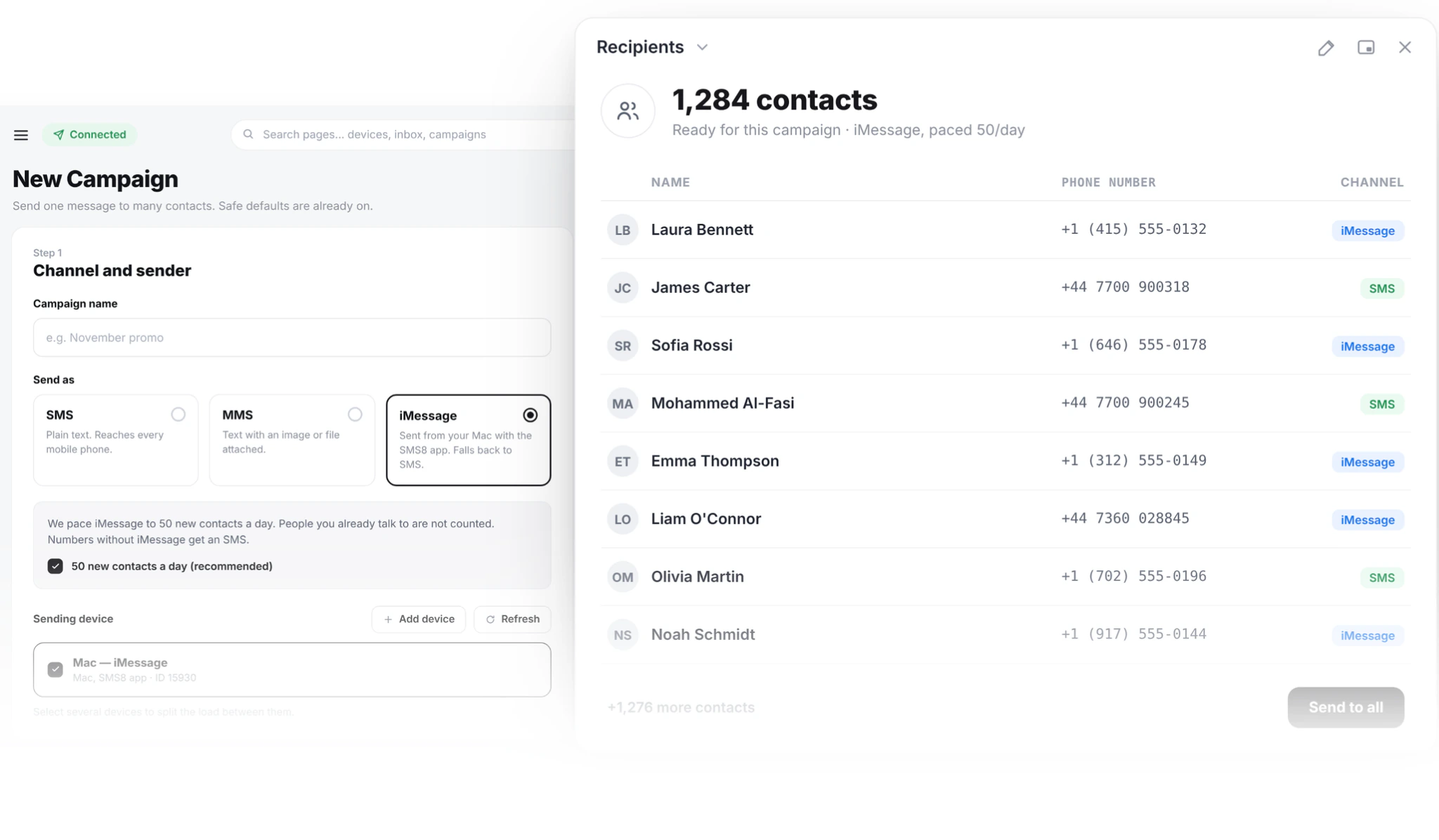
The paired-phone model wins on cost, recognition, and speed. The virtual-number model wins at scale beyond about 10 devices and when you need programmable long codes across many countries at once. Most teams under a million SMS per month are better served by the paired model. Above that, hybrid setups (transactional through paired phones, top-of-funnel through a carrier network) are common.
List quality is upstream of everything
A campaign with a great list beats a great campaign with a mediocre list, every time. Three quick tests to run on any list before you send.
Freshness. When did each contact last opt in or engage? Numbers untouched for over 18 months are the leading cause of unsubscribes and STOP replies. Segment them out and either a warm-up sequence or a re-permission ask is worth the small volume hit.
Validity. Are the numbers in E.164 format? Do they have a plausible country prefix? SMS8 validates on CSV import and surfaces malformed rows before send, but the fastest wins come from cleaning the source system, not patching each export. Check for missing country prefixes, leading zeros stripped by spreadsheet software, non-numeric characters, and duplicate rows before you upload.
Segmentation. The single biggest lever on reply rate is not the copy. It is who receives it. A promo sent to "customers who opened last three broadcasts and viewed the collection page in the last 14 days" outperforms a broadcast to the whole list by roughly ten to one on revenue per subscriber. Building segments is a couple of SQL views if you have a warehouse or a couple of tags on your contacts if you do not. Start with three: recent buyer (30 days), engaged non-buyer (opened in 90 days), dormant (no engagement in 180 days). Cadence caps differ per segment.
The six campaign patterns worth shipping
Bulk SMS covers a lot of use cases but the shipping list is short. Six patterns do most of the work.
1. Abandoned cart with a 47-minute delay
A single SMS, sent 47 minutes after cart abandonment, naming the specific item, linking to the cart. Not the homepage. Not a coupon page. The cart. Conversion rates land between 8 and 15 percent when the delay is right and the copy is tight. Sent five minutes after abandonment (a common misfire), conversion halves and the STOP rate doubles because the recipient perceives surveillance.
2. Back-in-stock notification at the moment inventory updates
The highest-converting play in the guide. 12 to 25 percent conversion is typical because the recipient explicitly asked to be told. The mistake is queueing all back-in-stock notifications for a daily 11am send. Fire the SMS the instant the inventory webhook reports the SKU went from zero to non-zero.
3. Appointment reminder 24 hours before
Not marketing in the classic sense but this is the highest-ROI bulk SMS pattern in healthcare, salons, and services generally. A single reminder 24 hours before the appointment cuts no-shows by 35 to 55 percent. A second reminder 2 hours before adds another 5 to 8 percent, at a diminishing cost. A third reminder does more harm than good.
4. Flash sale to a warm segment, not the whole list
Broadcasts to the whole list are the reason SMS lists die. Flash sales work when the segment is warm (opened at least one message in the last 90 days) and the offer is time-boxed (24 hours, not "this week"). Reply rate on warm-segment flash sales in the SMS8 dataset averages 4 to 8 percent revenue lift on the segment; the same broadcast to a cold list averages 0.3 percent lift and a 1.5 percent unsubscribe rate.
5. Post-purchase review request three days after delivery
SMS review requests usually get far more responses than the same request by email. The timing matters. Two hours after delivery, the product is not tried yet. Three weeks after delivery, the moment is gone. Three days is the sweet spot for consumer goods; adjust for your category.
6. Win-back for lapsed customers, capped at once a quarter
3 to 8 percent reactivation on a good list. The rule is one message per quarter. Two win-back messages in the same month cluster the unsubscribes and burn the segment permanently.
Each of these patterns has its own copy template, send-time rule, and metric to watch. If you A/B test one variable at a time, test send-time first, then segment definition, and only then copy. Copy variants tend to move conversion 5 to 10 percent; timing and segmentation move it 30 to 200 percent.
Deliverability, in the parts that actually matter
Deliverability writing on the web is often dominated by carrier-network worries (SHAFT filtering, sender-ID reputation, campaign approval status). On paired-device sending, the concerns are different and simpler.
Rate ceiling per SIM. SMS8 campaigns send one message every 10 to 30 seconds on each SIM, a pace carriers read as normal use. Sending much faster for sustained periods risks the SIM being flagged. SMS8 paces automatically and distributes across paired devices; to reach a big list faster, add SIMs or phones.
Reboot windows. A paired Android that reboots takes about 20 seconds to reconnect. Long broadcasts that run through a reboot lose 10 to 30 messages; SMS8 catches and retries them automatically. On very long broadcasts (over 100k SMS), plan the send to run during charging hours to minimise this.
International reach. Whatever your SIM can text, SMS8 can broadcast to. Most consumer plans include international SMS at a per-message rate or bundled. Two SIMs on the same account is a common setup for teams covering two regions with local sender IDs.
Compliance basics: what regulators actually enforce
Every jurisdiction has SMS rules. The details differ but the three constants across TCPA (US), GDPR + PECR (EU/UK), CASL (Canada), and PDPA (Australia) are the same.
Opt-in before you send. Assumed consent is not consent. Keep the record of when, how, and via which form each contact opted in.
Identify yourself in the body. "Hi from Acme" at the start of the first SMS to a new contact. Do not hide the identifier in a footer nobody reads.
Honour STOP. Any reply containing STOP, UNSUBSCRIBE, CANCEL, END, or QUIT must immediately remove the recipient from every list on the account. SMS8 does this automatically across every list on the account. The keyword set that catches 99 percent of opt-outs is STOP, UNSUBSCRIBE, CANCEL, END, QUIT, REMOVE and their common misspellings.
Two jurisdictional specifics worth calling out. In the US, TCPA fines start at 500 dollars per violation and triple for willful violations; class actions are common. In the UK and EU, marketing SMS to consumer numbers without prior specific consent triggers the regulator's biggest fine bracket. Both are recoverable via a clean opt-in flow; neither is recoverable via good intentions after the fact.
Cost, with a real example
Consider a small ecommerce team sending 30,000 bulk SMS a month. Half are abandoned cart and back-in-stock (transactional-adjacent). Half are broadcast marketing (flash sale, weekly digest, review request).
On Twilio (prices as listed on their US SMS pricing page in November 2026): 30,000 SMS at $0.0083 each is $249. Carrier fees add $0.0035 to $0.0045 per message, another $105 to $135. Plus $1.15 a month for a long code, plus A2P 10DLC brand registration and a monthly fee per campaign. Rough monthly run rate: $355 to $385 before the 10DLC fees.
On SMS8: one paired Android phone on the USD 29 per month plan (half that billed yearly). No per-message fee from SMS8; your SIM's mobile plan applies. Setup fees: zero. Recipient sees a real mobile number. See SMS8 pricing for the multi-phone plans.
The cost difference is not the whole story. Sending from a number your customers recognise tends to lift replies, and that is often what justifies the switch on its own; the cost saving is a bonus. Measure it on your own list: run the same campaign to two comparable segments and compare reply and conversion rates.
Measurement: three metrics, not thirty
The temptation is to instrument everything. The reality is that three numbers tell you almost the whole story.
Reply rate per campaign. Not click rate. Reply rate. A reply is a much stronger signal of intent than a click, and on real-number sending it is finally frequent enough to measure. Target: above 5 percent on well-targeted broadcasts.
Unsubscribe rate per campaign. Below 0.5 percent is healthy. Above 1 percent means the segment, the cadence, or the copy is wrong. Above 2 percent, stop sending to that segment and re-permission.
Revenue per subscriber per month. The strategic number. Everything else feeds this. If it is growing, you are doing something right; if it is shrinking, the tactical metrics will tell you where the leak is.
Send-time is the largest and most under-optimised lever on any of these metrics. Tuesday to Thursday, 10am to 2pm local time for consumer retail. Friday late afternoon for weekend offers. Sunday before noon and any weekday after 8pm both correlate with higher unsubscribe rates.
Getting started: what to build this week
If you are moving off Twilio or setting up bulk SMS for the first time, sequence matters. Do these in order.
Day 1. Start the SMS8 3-day trial with 30 messages (no card needed). Install the app on a spare Android. Pair it. Send a test broadcast of ten messages to a list you control (yourself, colleagues, family who consented). Confirm the recipients see your real number and that replies land in the SMS8 inbox.
Day 2 to 3. Clean one list from your current source system: strip non-numeric characters, fix missing country prefixes, dedupe. Import to SMS8. Send one real campaign to a warm segment. Measure reply rate, unsubscribe rate, and revenue.
Week 2. Add STOP compliance sanity check (test that a reply of STOP actually removes the recipient). Set quiet hours in the dashboard. Add a webhook to your backend for replies so the sales team can act on them.
Week 3 to 4. Layer in one behavioural trigger (abandoned cart or back-in-stock, whichever fits). Watch conversion. Compare to whatever your previous provider was doing on the same trigger.
By week 4 you have a working bulk SMS channel with better economics and better response than what you had before. From there, the sequence is patterns 3 through 6 in the list above, on the timelines that make sense for your business.
Why choose SMS8 for bulk SMS marketing
SMS8 is built for exactly this: campaigns from your own number on one flat plan.
- Your own number. Texts leave from the SIM in your own Android phone, so customers see a number they know and can reply to.
- A flat price with unlimited messages. USD 29 a month for one phone or Mac, USD 89 for five and USD 229 for twenty, with unlimited SMS and MMS and no per-message fee. Yearly billing is half the price.
- No A2P 10DLC filing. Texts go person-to-person from your SIM, so there is no brand, campaign or monthly campaign fee to manage.
- Scale by adding phones. Each SIM sends one message every 10 to 30 seconds, and SMS8 spreads campaigns across every paired phone.
- SMS, MMS and iMessage in one inbox. Pair Android phones for SMS and MMS and a Mac for iMessage with SMS fallback, then answer everything from one shared inbox.
- Setup in minutes. Install the app, pair the phone and copy your API key. The 3-day trial includes 30 messages and needs no card.
Start the 3-day trial with 30 messages and no card, or compare plans on the SMS8 pricing page.