
Part of the guide SMS Integrations: Zapier, Make, n8n, WordPress, Google Sheets
On this page
- The short version
- Why this specific opportunity, and why now
- The service tiers that work
- The economic model, plainly
- What you're actually selling
- Hardware operations: the part nobody talks about
- The white-label question
- Tooling: the actual stack
- The legal scaffolding
- The first 90 days: how agencies actually launch this
- What goes wrong, specifically
- Adjacent service lines that compound well
- The five-year view
- What to do this week
- Tools and references
- Why agencies build this service on SMS8
The short version
A new service line has quietly become one of the highest-margin offerings inside e-commerce and retention agencies in 2026: managed SMS infrastructure. The model: the agency owns and operates a fleet of Android-phone-based SMS gateways, one per client. The client pays $3,000 to $7,000 per month for a fully managed retention channel that costs the agency $80 to $200 per client per month in hard costs. The worked example below lands well above 70% gross margin, because labor, not infrastructure, is the main cost. The key constraint is that this is not an SMS-sending service. It's a managed retention service that happens to use SMS as the delivery layer. Agencies treating it as a Twilio reseller business burn out quickly. Agencies treating it as a retention consultancy with infrastructure scale. The automations themselves run through the SMS8 integrations, such as the GoHighLevel SMS integration many agencies already use, Zapier, Make or n8n.
Why this specific opportunity, and why now
The agency landscape in marketing services has shifted three times in the last decade. From SEO services in the mid-2010s, to paid social and Meta ads in 2018-2022, to short-form video and creator partnerships in 2023-2025. Each cycle compressed margins as tools commoditized and clients learned to do it themselves. The agencies that survived each transition tended to be the ones who climbed the value chain, moving from execution to strategy, from doing the thing to managing the system.
SMS retention is at an earlier point in that curve. Most clients can't do it themselves because the infrastructure is non-obvious. They know they should be sending SMS, they've heard the open rate numbers, but the gap between "we should do this" and "we have a working program with eight automations, segmented sends, and compliance monitoring" is wide. That gap is where agencies get paid.
What's new in 2026 is the cost side of the equation. Two years ago, an agency wanting to manage SMS for a client had to either resell Twilio (low margin, brand confusion) or build complex multi-tenant infrastructure (high upfront cost, ongoing maintenance burden). Today, an Android-phone-based gateway costs $180 in hardware plus $35/month in SIM costs, and the management dashboard is provided by services like SMS8. The infrastructure stack that used to require an engineering team is now a checklist a non-technical operations person can run.
The window will not stay open forever. Within 3-5 years we expect either large agencies to systematize this, or vendor-managed offerings to absorb it. The agencies who establish positioning, case studies, and client relationships in the next 18 months will be hard to displace.
The service tiers that work
Most agencies running this play settle into three tiers. The ranges below are a pricing model to start from, not survey data. Adjust them for your market and client size:
Starter
$2,800 to $3,500/mo
- 1 dedicated gateway
- Up to 10,000 SMS/month
- 4 behavioral automations
- Monthly reporting
- Compliance monitoring
Growth (most common)
$4,500 to $6,500/mo
- 1 to 2 gateways
- Up to 25,000 SMS/month
- 8 to 12 behavioral automations
- Weekly reporting
- Monthly copy refresh
- Quarterly strategy review
- 2-way reply routing
Scale
$7,500 to $12,000/mo
- 3+ gateways (multi-region)
- Unlimited volume
- Custom automations
- Real-time reporting dashboard
- Weekly copy testing
- Embedded retention strategist
- API and platform integrations
The price clustering at the Growth tier is no accident. It maps to what direct-to-consumer brands in the $2M-15M annual revenue range can absorb as a single line item without going through a procurement review. Above $7,500/month, sales cycles lengthen substantially, often by 3-4x. Below $3,000/month, the client tends to compare directly to Klaviyo's SMS module ($150/month + $0.012/SMS, as listed on their site in May 2026) and the cognitive load of justifying the difference exceeds the agency's willingness to defend the price.
The economic model, plainly
Take a Growth tier client at $5,000/month. The agency's costs:
| Cost | Monthly | Notes |
|---|---|---|
| Android phone (amortized) | $8 | $200 hardware ÷ 24 months |
| SIM card / unlimited plan | $35 | Pre-paid carrier plan, US market |
| SMS gateway service (per device) | $29 | SMS8 One Device plan |
| Hosting (n8n automations) | $8 | Cloud n8n base, shared across clients |
| Storage and DB (allocated) | $5 | Allocated portion of agency infra |
| Account management (8-12 hrs/mo) | $600 to $900 | $75/hr blended rate |
| Copy and creative (4 hrs/mo) | $200 to $320 | $80/hr blended rate |
| Total cost per client | $885 to $1,305 |
At $5,000 revenue and ~$1,100 cost, gross margin is approximately 78%. That margin assumes labor is the dominant cost. If you can systematize account management to under 6 hours per client per month, margin climbs above 85%. The agencies running this play at scale invest heavily in automation of their internal workflows: client onboarding checklists, automated weekly report generation, templated campaign launches.
At 20 clients on the Growth tier, the math becomes interesting: $100,000/month gross revenue, ~$22,000/month direct cost, $78,000 contribution margin before agency overhead. That's a 12-person agency footprint generating just under $1M of contribution from one service line.
What you're actually selling
The single most important mental shift for agencies entering this space is understanding that you are not selling SMS. You are selling retention infrastructure as a managed service. The distinction matters because clients price these things very differently.
If you sell "SMS marketing services," the comparison set is Klaviyo, Attentive, Postscript, and other vendor platforms. Your $5,000 is benchmarked against their $1,500-2,500 software fees plus a campaign manager hire. You lose this comparison.
If you sell "managed retention channel + customer reactivation program + segmentation and compliance," the comparison set is hiring a retention manager ($85k-110k salary, plus tools, plus benefits, call it $10k-15k loaded monthly cost). Your $5,000 looks like a bargain.
The pitch deck pages that move the needle:
- Current state diagnostic. "Here's what we found auditing your current SMS setup. You're sending X messages with Y% conversion. Industry benchmark is Z. The gap is $N of revenue per month you're leaving on the table."
- What we'll change. The specific automations you'll build, the segments you'll define, the compliance issues you'll fix. Make it tangible.
- The infrastructure. Briefly explain that you operate a dedicated gateway per client. Don't dive into Android phones unless asked; the client doesn't care about your supply chain. They care that you own your stack.
- Reporting cadence. Weekly report sample, monthly review, quarterly strategy. Cadence reassurance is undervalued: most agencies under-promise on reporting and then over-deliver, which is good for retention.
- Pricing. One number, no per-message rates, no surprise overages. The flat fee is part of the value proposition.
Hardware operations: the part nobody talks about
The unsexy reality of running this model is that you are now operating a small phone farm. The agencies that fail at scale do so because their hardware operations don't scale linearly with revenue. The ones that succeed treat hardware as a discrete operational discipline.
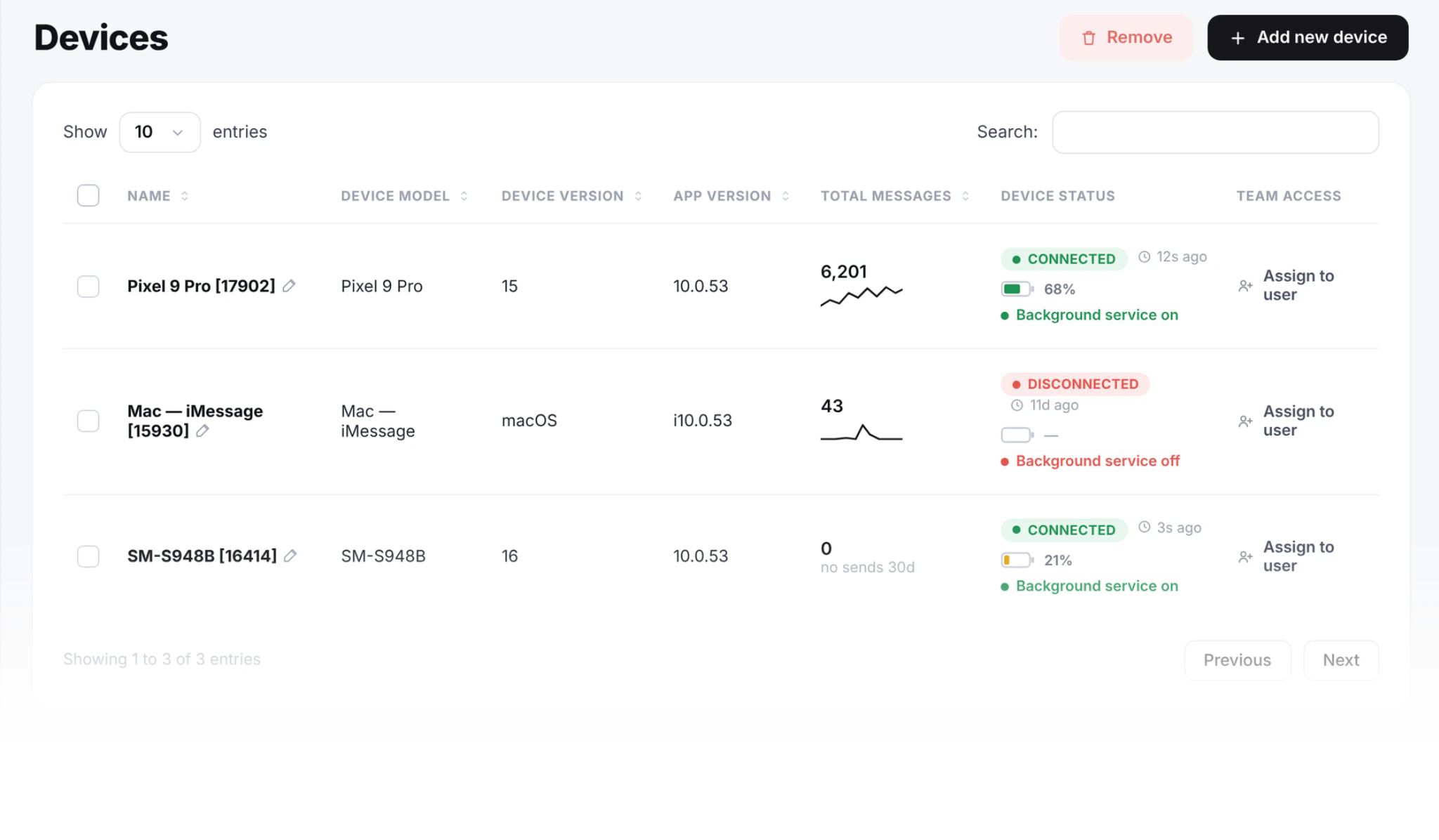
Three patterns that work:
Pattern 1: In-office rack (up to 15 clients). A purpose-built rack in your office holds 15-20 Android phones, each with always-on power, dedicated WiFi (separate VLAN from staff WiFi for security), and physical labels matching the client account. Cost: ~$2,000 setup including rack, cabling, switch. Maintenance: ~2 hours/week for a junior ops person.
Pattern 2: Co-location with a managed phone host (15-50 clients). Phone-hosting providers can take the devices off your hands. Typically they provide power, network, physical security, and a remote KVM-like interface for restarting devices. Cost: $25-40 per phone per month. Removes the office operational burden but adds vendor dependency.
Pattern 3: Distributed phone farms (50+ clients, multi-region). Agencies serving international clients need phones in the recipient's jurisdiction (a UK number sending to UK recipients, US to US, etc.). At scale, this means relationships with co-location partners in each major market. The agencies operating this way have moved closer to telecom operations than marketing services.
The transition points are roughly: in-office until 15 clients, co-located 15-50, multi-region above 50. Skipping the in-office stage tends not to work because the team learns the operational quirks (failed sends, SIM authentication issues, OS update cycles) by handling the hardware physically before trying to manage it remotely.
The white-label question
Most agencies want their clients to see the agency's brand on every interface. SMS8 offers white-label as an enterprise option: your client logs into a dashboard at sms.youragency.com rather than app.sms8.io, and reporting comes from your brand. Pricing is quoted per agency.
Whether white-labeling is worth it depends on positioning. If you're competing for clients who do their own evaluation of vendor stacks, white-labeling protects you from the client realizing they could buy the underlying service directly. If you're competing on strategic expertise and the client buys your judgment, the underlying platform's brand is less important: many agencies are transparent with clients about which infrastructure they use, and clients don't mind.
The argument for white-labeling: protects the agency from disintermediation. The argument against: feels like hiding the ball, which sophisticated clients dislike. A common middle ground is white-labeling for the largest accounts and staying transparent below that.
Tooling: the actual stack
What a typical agency stack looks like for this service line:
| Layer | Tool | Why |
|---|---|---|
| Gateway hardware | Pixel 5/6/7 + carrier SIM | Cheap, reliable, easily replaced |
| Gateway software | SMS8 | Multi-device dashboard, API, webhooks |
| Automation | n8n (self-hosted or cloud) | Open, flexible, no per-flow pricing |
| Data pipeline | Postgres or Airtable per client | Single source of truth for segments |
| E-commerce hook | Shopify/Woo webhooks | Trigger source for behavioral plays |
| Reporting | Metabase or Grafana | Auto-generated weekly client reports |
| 2-way replies | LLM intent + human review queue | Scale support without scaling headcount |
| Internal docs | Notion or Slite, one page per client | Onboarding handoff, ops continuity |
This stack is open-source-friendly. Total tool cost for an agency running 20 clients is typically $400-800/month, dominated by hosting and the white-label SMS8 option. Compare to running the same operation on Klaviyo + Postscript, where per-message and per-flow fees would run $8,000-15,000/month in software costs alone.
For agencies just starting out, the SMS8 API documentation covers the integration points you'll use most: sending SMS, receiving SMS webhooks, querying device status, and listing inbox messages. The n8n automation recipes post walks through importable workflows for the most common plays.
The legal scaffolding
This section is not legal advice
It's a description of contractual patterns we see agencies use, derived from agency interviews and published MSAs. Have your jurisdiction-appropriate lawyer review before signing anything.
The contract structure that holds up under stress assigns clear responsibility for the three risk categories: consent ownership, data handling, and service availability.
Consent ownership rests with the client. The client is the one who collected opt-in from each recipient (at checkout, via a signup form, or through whatever opt-in mechanism they use). The agency operates the channel but does not claim the recipient relationship. This matters legally because TCPA and equivalent laws hold the entity with the prior business relationship accountable for compliance.
Data processing terms cover PII. The agency receives names, phone numbers, sometimes purchase history. In the EU, UK, and California, the client is the data controller and the agency is the data processor. A standard DPA assigns responsibilities for breach notification, sub-processor disclosure, and data deletion on contract termination.
Service availability is bounded. The agency commits to gateway uptime (typically 99.5%) and message delivery attempts within a defined window (typically "within 60 seconds of trigger event"). The agency does not commit to recipient mobile carrier delivery, conversion rates, or revenue outcomes. Those depend on too many variables outside the agency's control.
The other clause worth including: a clean offboarding path. When a client cancels, what data leaves with them? Most agencies commit to providing a CSV export of all opt-in records and sent message history within 14 days, after which data is deleted. This protects both parties and is usually a deciding factor for sophisticated clients during contract negotiation.
The first 90 days: how agencies actually launch this
The pattern that works for agencies adding SMS as a service line:
Days 1-14: Internal build. Provision two test gateways. Build out one internal Shopify store (your own or a friendly partner's) and run all 12 plays from the SMS marketing playbook end-to-end. Document every automation. Identify the operational quirks you'll explain to clients later. This is the most important step and agencies that skip it end up with shaky launches.
Days 15-30: First case study. Pick one existing client, ideally a Shopify store between $2M and $8M in revenue, and offer them a 60-day pilot at $1,500/month or free with a case study clause. The math is bad short-term: you're losing money on the pilot once you account for setup time, but the case study is the most valuable asset you can have when you go to market.
Days 31-60: Refine and document. Run the pilot, refine the operational playbook, build internal automations for onboarding and reporting. The biggest time sink in this phase is creating the client-facing reporting templates. Spend the time; this is what you'll be sending every week for the next two years.
Days 61-90: Soft launch. Approach 3-5 existing clients you've identified as fit. Pitch as the new service line, lead with the case study from days 15-60. Aim for 2-3 closed deals at the Growth tier. Don't go to cold outbound until you have 4+ retainers active; you need the social proof and the operational maturity.
From day 90: ramp through referral and outbound. The agencies that grow this service line fastest tend to be the ones who had a defined client persona, a clear case study, and a documented operational playbook before going broad. The agencies who tried to ramp through cold outreach without those three pieces tended to churn early clients and damage their reputation.
What goes wrong, specifically
Six failure modes we see, in order of how common they are:
1. Underpricing the operational work. Agencies set the price at $3,000/month and then find themselves spending 15-20 hours per client per month on copy, account management, and reactive support. Margin collapses. The fix is to push the lowest tier to $3,500 minimum and gate it on volume (under 10k SMS/month) to limit operational load.
2. Treating SMS as a service add-on rather than a discipline. Agencies that bolt SMS onto existing service offerings without dedicated account management end up with mediocre results because nobody owns the channel. The agencies that succeed have at least one person whose primary job is SMS retention, not SMS plus four other channels.
3. Hardware failures eating margin. The first time a phone bricks at 2am during a flash sale and a client misses a send window, the operational lesson lands hard. Agencies that scale build in redundancy: a second phone per client provisioned but inactive, ready to take over via a DNS-level swap. This costs an extra $8/month per client in amortized hardware and is worth every cent.
4. Compliance drift. Six months in, an agency realizes one client's opt-in flow doesn't meet TCPA standards but they've been sending to that list anyway. Now you have legal exposure. The fix is compliance audits at month 1 and quarterly thereafter, with documented findings sent to the client. This protects you and forces the conversation about opt-in quality.
5. Client churn from over-attribution. Agencies that take credit for revenue SMS didn't actually drive get caught when the client runs an attribution audit. Be conservative on attribution: prefer click-through clicks with UTM parameters, post-purchase survey data ("how did you hear about this offer"), and incremental holdout tests where you can.
6. Scaling client count without scaling operations. The transition from 10 clients to 30 breaks most agency operations models if account management hasn't been systematized. Templated weekly reports, automated alert routing for gateway issues, standardized onboarding flows: these have to exist before client #20 or the wheels come off.
Adjacent service lines that compound well
Agencies doing SMS retention as a standalone service typically expand into adjacent service lines that share infrastructure and client overlap:
- Email retention. Same client persona, same automation logic, different channel. Pair SMS and email retention as a single offering for a $7-10k/month bundle.
- Customer support automation. The 2-way SMS reply infrastructure (play 12 in the marketing playbook) is the same plumbing needed for SMS customer support routing. Sell it as a $1,500-2,500/month add-on.
- OTP-as-a-service. Some clients want SMS verification for their app or signup flow but don't want to wire up Twilio. The same gateway you're using for marketing can handle OTP delivery. See our OTP API guide for the integration pattern.
- Compliance-as-a-service. For clients in regulated industries, monthly compliance audits of their entire SMS + email program is a $2-4k/month add-on that costs you 4 hours per client.
The agencies running this play well think of SMS as the wedge into a broader retention practice, not as a standalone deliverable.
The five-year view
This opportunity will not last forever in its current form. Three things will change between now and 2030:
Vendor platforms will absorb the workflow. Klaviyo, Attentive, and Postscript will eventually offer fully-managed services that bundle the infrastructure they don't yet have (your gateway) with the platform they do. Agencies competing on infrastructure margin will be squeezed. Agencies competing on strategy and execution will survive.
RCS and rich messaging will fragment the channel. By 2028 RCS penetration in major markets will be high enough that "SMS marketing" becomes "messaging marketing," with rich media, interactive replies, and verified-sender branding. The agencies that learn RCS workflows early will have a stronger position.
AI-generated copy and automated segmentation will commoditize the tactical work. Today, "writing 4 SMS templates per month per client" is part of the deliverable. By 2027, that work will be largely automated. The strategic layer (what to send, to whom, when, with what offer) will remain valuable. Agencies pricing themselves on copy production volume will be out-competed.
None of these changes invalidate the model. They reshape what the high-margin layer is. The agencies who establish positioning and case studies now will have a multi-year head start on the wave behind them.
What to do this week
If you're an agency owner considering this:
- Spend $250: buy a used Pixel 6, a prepaid SIM, and sign up for an SMS8 One Device plan. Provision your own gateway end-to-end.
- Pick one existing client whose retention you already know well. Build the first 4 plays (abandoned cart, post-purchase, win-back, VIP early access) for them as a pilot. Document everything.
- Write the pitch deck while the pilot is running. The deck you write before having a case study will be the deck you regret. Wait for week 4 of the pilot before going to market.
- Decide on tier pricing for your market. Look at the table above as a starting point, then adjust for your geography, client size, and competitive landscape.
- Hire or assign one person whose job is this service line. Not a half-time assignment; this needs an owner.
The infrastructure is cheap and accessible. The opportunity is real. The agencies who move in the next 18 months will be selling retention infrastructure as a managed service for the rest of the decade. The agencies who wait will be competing against them as cost-plus resellers.
Tools and references
- SMS8 Android SMS gateway: the core infrastructure, with multi-device dashboard and per-client isolation.
- SMS8 REST API documentation: endpoints for sending, receiving, and device management.
- SMS marketing playbook 2026: the 12 plays your agency will be deploying for clients. Companion piece to this guide.
- n8n SMS automation recipes: importable workflows for the plays.
- WordPress SMS plugins compared: for clients whose store runs on WooCommerce.
- Building an SMS OTP API on Android: for the OTP-as-a-service adjacent line.
- Webhook vs polling for incoming SMS: for designing the 2-way reply architecture.
- Twilio alternatives in 2026: context for the cost comparison when pitching clients.
- SMS cost calculator: model the unit economics for prospect pitches.
- SMS8 affiliate program: for agencies who refer clients directly to SMS8 in addition to running managed services.
Why agencies build this service on SMS8
For an agency, SMS8 keeps hard costs flat per client while the retainer stays the same.
- A flat price with unlimited messages. USD 29 a month for one phone or Mac, USD 89 for five and USD 229 for twenty, with unlimited SMS and MMS and no per-message fee. Yearly billing is half the price.
- Your own number. Texts leave from the SIM in your own Android phone, so customers see a number they know and can reply to.
- No A2P 10DLC filing. Texts go person-to-person from your SIM, so there is no brand, campaign or monthly campaign fee to manage.
- Built into GoHighLevel. The official marketplace app makes your phone or Mac the SMS provider for a sub-account, so workflows and Conversations keep working.
- Scale by adding phones. Each SIM sends one message every 10 to 30 seconds, and SMS8 spreads campaigns across every paired phone.
- API, MCP and integrations. A REST API with signed webhooks, an MCP server at mcp.sms8.io, and official apps for GoHighLevel, Zapier, Make, WordPress and Google Sheets.
Start the 3-day trial with 30 messages and no card, or compare plans on the SMS8 pricing page.